Mapping information risks and mitigations for election integrity in 2026
Threats to journalists, especially women journalists, are a top Information risk in the upcoming local government elections, alongside the threat of an expected flurry of deepfakes.
These insights emerged from a brainstorm of 20 people at a meeting convened by SANEF and MOXII Africa (formerly Media Monitoring Africa) on 9 February, held at the SANEF offices in Johannesburg. The document can be accessed here.
The likelihood and severity of unfounded attacks on the IEC were also ranked as high risk by the participants, as was also the prospect of online and offline attacks and intimidation of officials exposing municipal corruption.
The workshop involved representatives from the IEC, media houses, one of the big tech companies, researchers and civil society support groups.
A similar human rights risk assessment was done ahead of the 2024 national government elections, providing the model in 2026 and feeding into the coalition activities of the UNESCO-supported Social Media For Peace SA (SM4P) programme, of which SANEF and MOXII are members.
The workshop pooled people’s insights into mapping what risks to information integrity could be expected in 2026 to pose a serious threat to election integrity. The group also proposed mitigations by both media and big tech. They identified three categories of threats:
Risks to expression – intimidation of the public and the media
Disinformation regarding voters’ access to information
Threats to the electoral process, such as attacks on the credibility of the IEC.
According to participants, amongst the ways that media people can help counter the risks are:
Building journalistic credibility by showing the public “how the news sausage is made”
Organising solidarity and specialised training for journalists, and reinforcing codes of conduct
Setting up a rapid response capacity to alert the public about deepfakes, such as impersonations of IEC officials
Working with researchers and civil society
Steps that tech platforms can take were also proposed. These are to:
Re-publicise and enforce their terms of service to remind users that incitement is forbidden conduct on these services
Detect election-related content that threatens information integrity, and moderate it accordingly
Support fact-checking
Be transparent about plans relating to election integrity and give researchers access to data.
The South African National Editors’ Forum (SANEF) expresses its profound sadness and extends heartfelt condolences on the passing of veteran SABC journalist Veronica Fourie, a deeply respected and much-loved figure in South Africa’s media landscape. Fourie passed away on Monday morning after a courageous battle with ovarian cancer.
Fourie, who had been enjoying her retirement in Jeffreys Bay, passed away in an ambulance on her way to the hospital. Despite her illness, her family and friends remember her as a woman who faced her struggle with extraordinary grace, wisdom, and her signature “slash of red lipstick.”
Known affectionately as “Tannie V,” Fourie began her professional life as a qualified teacher before finding her true calling in news. Her career spanned decades across major South African publications and broadcasters:
She made her mark at The Herald, Die Oosterlig, and Die Burger Eastern Cape. She then spent over 20 years at the SABC newsroom in Gqeberha, where she flourished in radio and television.
Her colleagues noted that her personal experience with the loss of her child in a car crash gave her a unique empathy, making her the “go-to” person for difficult or emotional interviews.
SABC News Eastern Cape Editor Jurie Blignaut remarked, “On radio, her words came alive. With that warm touch, she could coax an interview from even the most recalcitrant guest. Her contribution to SABC news is still felt today.”
“Human interest features were her forte. She had a knack for covering crime and courts, as her stellar coverage of the Jayde Panayiotou murder indicated. By telling the human story, she was able to make the information easily accessible. With that warm touch, she could coax an interview from even the most recalcitrant guest,” Blignaut recalled.
In her retirement, Fourie remained active in the craft she loved, freelancing for the Kouga Express and writing her popular weekly column, “Veronica Vertel” (Veronica Tells).
Bettie Giliomee-Rossouw, GM of EP Media, and Kathryn Kimberley, The Herald news editor, both recalled Fourie as a larger-than-life personality who mentored scores of young journalists. “She shared her knowledge and skills freely,” said Blignaut. “She was an office mother who was a shoulder to cry on and a hand to support.”
Fourie was as famous for her vibrant personality as she was for her reporting. Her daughter, Erika Ferreira, shared that her mother never let cancer dampen her spirits.
“After her first chemo session, she lost her hair. But it did not faze her because she loved wearing hats so much. Just last weekend, she was at a family wedding and danced. She made every moment count.”
Her longtime friend and former colleague Janine Lee recalled their 25 years together at the SABC, where they were known as “007” for their playful office pranks. Lee noted Fourie’s favourite mantra for facing adversity: “Put on your lipstick, put on your hat, and just get on with it.”
Fourie is survived by her daughter Erika Ferreira and son-in-law Dawson; her son Dr. Ruhan Fourie; and her beloved grandchildren, Yula and Heston Jr. Ferreira.
SANEF extends its deepest sympathies to the Fourie family and the many colleagues whose lives were touched by “Tannie V.”
ENDS
Note to Editors:
The South African National Editors’ Forum (SANEF) is a non-profit organisation whose members are editors, senior journalists, and journalism trainers from all areas of South African media. We are committed to championing South Africa’s hard-won freedom of expression and promoting quality, ethics, and diversity in the South African media. We promote excellence in journalism by fighting for media freedom, writing policy submissions, conducting research, and providing education and training programmes. SANEF is not a union.
The South African National Editors’ Forum (SANEF) is deeply saddened by the passing of renowned KwaZulu-Natal journalist and editor, Dennis Pather, who died peacefully at the age of 80 on Sunday, December 7, 2025, in Durban.
His remarkable career spanned decades, during which he made significant contributions to South African journalism and mentored countless aspiring journalists.
Dennis Pather’s storied journey in journalism began in 1967, following his studies at the University College at Salisbury Island, which became the University of Durban-Westville in 1972, and in 2004 merged with the University of Natal to become the University of KwaZulu-Natal (UKZN). He began his career as a reporter for Post and Drum magazine, followed by pivotal roles at The Leader and The Graphic.
Pather’s career flourished as he joined the Argus Group of newspapers, serving as editor of numerous titles, including The Daily News, The Mercury, Independent on Sunday, and The Post. He concluded his illustrious career as the deputy editor of the Sunday Tribune in 2010.
In 2023, Pather published his memoir, Copy Boy, offering a candid reflection on his experiences in a newsroom and the evolution of journalism in South Africa. His literary contributions and editorial leadership left an indelible mark on the media landscape.
SANEF’s Treasurer-General, S’bu Ngalwa, praised Pather as a model editor who nurtured young talent.
“Dennis was a great mentor and a genuinely kind man. He took a chance on me as a starry-eyed 22-year-old and charged me with the responsibility to lead the Daily News’ politics coverage. Even when I doubted myself, I knew that Dennis believed in me and from there I never looked back,” said Ngalwa.
Edwin Naidu, a journalist nurtured by Pather, shared his heartfelt tribute: “Dennis Pather was a role model with a mischievous smile. He had a wonderful way with words and people. Many younger journalists, including myself, credit him with opening the door to a career in journalism. He encouraged me when I proposed a music column for teens in his publication, the Post. Instead of dismissing my handwritten letters, he hired me two years later at the Sunday Tribune. His influence will be sorely missed, but his legacy will live on as one of the country’s editing greats.”
Marlan Padayachee, a SANEF associate member and veteran journalist, reflected on Pather’s legacy: “Dennis chalked up a rich and colourful career in the newspapering world. He was one of the rare journalists who edited almost half a dozen titles across the Argus Company and Independent Newspapers. His last WhatsApp message to me on Diwali Day hinted at the challenges he faced with age, yet he continued to produce incisive socio-political commentary despite serious health issues. Dennis was a beloved figure in the Musgrave CBD, admired for his warmth, charm, and commitment to journalism.”
During his career, Pather was recognised for his excellence and dedication to journalism, including his prestigious Nieman Fellowship at Harvard University in 1987/88. He is remembered not only for his professional achievements but also for his deep-rooted commitment to mentorship and community engagement. Throughout his life, he remained an influential figure, actively participating in discussions on socio-political issues and inspiring new generations of journalists.
Pather’s contributions to journalism were further enriched by his international experiences, including a significant tenure in the Argus Company’s London bureau, where he honed his skills in one of the world’s most vibrant media landscapes. His ability to blend storytelling with a deep understanding of the human experience made him a formidable force in journalism.
As we remember Pather, we reflect on his remarkable journey from a copy boy to a celebrated editor.
SANEF extends its deepest condolences to Dennis Pather’s family, including his wife, Kay, their two adult children, Brendan and Neesha, and his beloved grandchildren. His legacy of nurturing talent and his unwavering passion for storytelling will continue to inspire those in the media industry.
Hamba kahle, Dennis Pather; your contributions to journalism and the lives you touched will never be forgotten.
END
Note to Editors:
The South African National Editors’ Forum (SANEF) is a non-profit organisation whose members are editors, senior journalists, and journalism trainers from all areas of South African media. We are committed to championing South Africa’s hard-won freedom of expression and promoting quality, ethics, and diversity in the South African media. We promote excellence in journalism by fighting for media freedom, writing policy submissions, conducting research, and providing education and training programmes. SANEF is not a union.
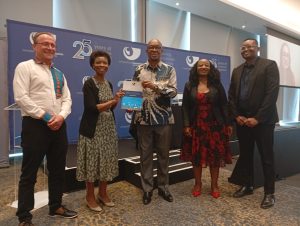
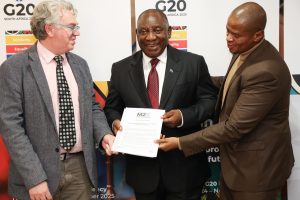
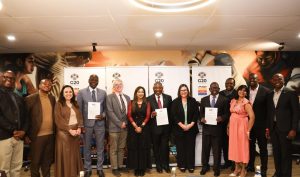
President Cyril Ramaphosa received the M20 Summit Declaration from MMA’s William Bird and SANEF Chairperson Makhudu Safara.
The leadership of the South African National Editors’ Forum (SANEF) and Media Monitoring Africa (MMA – (now called Moxii Africa)) met with President Cyril Ramaphosa on Tuesday afternoon to present the M20 Johannesburg Declaration, ahead of his meeting with G20 leaders on Saturday.
Makhudu Sefara, SANEF Chairperson, and William Bird, Director at MMA, explained to President Ramaphosa that the M20 Summit was organised against the backdrop of alarming threats to independent journalism, media viability, and an avalanche of physical and online harms. The summit also sought to uphold the rights of women and children and to prioritise information integrity for the public good.
President Ramaphosa expressed appreciation and support for the M20 Summit’s identification of critical elements recommended in its declaration, starting with the safety of journalists to address the global media landscape’s multifaceted challenges.
Key Elements of the M20 Johannesburg Declaration
The declaration outlines key areas for action by G20 nations:
Information Integrity: Facing a staggering increase in mis- and disinformation, the Summit stresses that independent media must reinforce the highest standards of journalistic ethics and develop robust mechanisms to uncover and counter disinformation campaigns, including those fuelled by Artificial Intelligence (AI). “Our integrity hinges on our commitment to deliver credible information to the public, particularly regarding climate sustainability and environmental protection,” the declaration states.
Safety of Journalists: The relentless persecution of journalists worldwide, “especially in war-torn Gaza,” must be condemned, with a call for an end to impunity for those who attack journalists during armed conflicts. The M20 stresses the urgency of solidarity in addressing not only physical violence but also the rising tide of online threats, “especially those targeting women journalists.” A global campaign must be initiated to demand justice for journalists whose lives and work are compromised by violence, intimidation, harassment and authoritarian repression.
Artificial Intelligence: The convergence of media and technology necessitates urgent dialogue on AI’s implications for journalism. The Summit advocates for ethical frameworks and policies that ensure fair compensation for journalists whose work feeds AI systems, alongside a commitment to transparency and accountability from technology companies in their usage of journalistic content. “This is especially vital for the Global South, where vulnerabilities in technology deployment are most pronounced.”
Media Viability and Freedom: Recognising that the media ecosystem faces an era defined by the financial crisis of journalism and mounting threats to media freedom, delegates called for G20 nations to take decisive steps toward establishing sustainable funding models for independent media that prioritise public interest journalism. They emphasised that the media’s viability “is not merely an economic issue; it is foundational to democratic health and preservation of free societies.”
Perspectives on the M20 and Media’s Role
Tshamano Makhadi, Deputy SANEF Chairperson, highlighted the historic nature of the event, noting that the M20’s Johannesburg Declaration will directly inform the G20 discussions.
“The summit marks a significant milestone in our nation’s history, not only as we become the first African nation to host such a pivotal meeting, but also for the South African media (the guardians of our democracy) to spearhead the M20 initiative, supported by over 80 South African and international organisations in shaping global policy especially on information integrity. These are the stories we will recount to our children and future generations,” Makhadi wrote in his social media account.
President Ramaphosa told the South African media that the M20 initiative was in itself a historic moment that was adding impetus to the story of South Africa’s achievements through the hosting of the G20.
“Where we go wrong, the media must be vocal, but where we do right, we want to hear the media to equally say yes … we are on the Global map and everybody is watching us,” he said.
He also stressed the media’s role in informing South Africans about the efforts that made the G20 events a success.
“Yes, we do have flaws like any country, it is an important historic moment when an African country which is laden with many problems and challenges is demonstrating that it can rise above them.”
The President also acknowledged the government was aware that the media sector was facing serious challenges of sustainability and survival, and that there was a need for government and media to engage constructively. He committed that his office would plan a constructive engagement on how the sector can continue operating in a safe environment.
“Our Constitution fully guarantees your freedom … as the government, much as sometimes you are the pain (somewhere), but one thing we will do, is to safeguard your freedom,” Ramaphosa said.
Earlier this year, in Beyond Compensation: Reshaping the Digital News Economy, I argued that the Competition Commission’s provisional report on the Media and Digital Platforms Market Inquiry (MDPMI) was significant not only for its headline figures, but because it sought to “fix the competition problem rather than simply compensate for the negative outcome”. It moved beyond a narrow pay-for-harm model and attempted to reshape the underlying digital market dynamics.
In a subsequent paper, Framing the Fight for Fairer Digital Markets, I assessed how a journalism-led civil society alliance convened by the South African National Editors’ Forum (SANEF) helped shape the Inquiry’s framing, scope and provisional findings. That analysis covered the alliance’s influence on rights-based framing, algorithmic opacity, structural remedies, AdTech, public broadcasting and generative AI.
This article picks up where those pieces left off. With the final MDPMI report now published, I offer a preliminary assessment of what has changed, what has been secured and where ambitions have been scaled back.
When the Commission launched the MDPMI in April 2023 it became one of the most active Global South bodies grappling seriously with platform power, media sustainability and the democratic value of independent journalism. In 2025 the provisional report hinted at an Inquiry willing to push beyond narrow competition doctrine. The final MDPMI report confirms that ambition but also the limits of a regulator confronting technology design and structural asymmetries that run far beyond national borders.
On 13 November 2025, the Minister of Trade, Industry and Competition Parks Tau received the report and committed to tabling it in Parliament within ten days before taking it to the Government of National Unity Cabinet.
At its best, the final report goes further than expected. It delivers a negotiated, enforceable funding package between the Commission and Google, establishes enforceable remedies for Meta, TikTok, Microsoft, X and OpenAI, creates new commitments on YouTube, includes remedies on the SABC and places a clear rights-based democratic framing at the centre of its analysis. Yet it also shows the limits of a negotiated remedy-based approach. The Commission can extract concessions, but a structural redesign of the market was always unlikely by a Global South country within the confines of this inquiry.
The negotiated settlement model also carries a major practical advantage: most of the remedies take effect immediately. Had the Commission pursued a purely adversarial or structural route, South Africa would likely have faced years of litigation, during which no support would flow to newsrooms, community media or the SABC at time of market failure and financial crisis. In this context, the settlement is pragmatic. It secures funding, transparency commitments, AI controls and enforceable obligations now, rather than deferring relief until after protracted court battles that the Commission, and the media sector, can ill afford to wait out.
A more direct — and overdue — account of platform-induced harm
The Commission’s final report places platform conduct in very direct terms, finding that the concentration of market power in search, social media and digital advertising is central to the weakening of news publishers, especially amid collapsing referral traffic and the rise of AI systems that summarise news without compensation. This is the strongest regulatory recognition to date that platforms extract value from news content while returning a diminishing share, and that these dynamics directly undermine the economic foundations of journalism.
The negotiated Google settlement: structured and verifiable
A key feature of the final report is the structured agreement between the Commission and Google, requiring aggregated R688 million ($40m) funding over five years, including:
R38 million per year for three years for a Digital News Transformation Fund (DNTF) for small and community media (already committed last year and therefore not new funding), followed by matching funding of R19 million per year for two years.
R71 million per year for five years for Google News Showcase for national publishers and broadcasters, including the SABC.
R45 million per year for three years for an AI Innovation Fund for mainstream media.
R11.6 million over three years in total training support for the full industry, including a provision on vernacular training in partnership with the Media Development and Diversity Agency (MDDA).
This package provides predictable multi-year support and is enforceable as a stipulated remedial action.
Plurality of funds, not a single media industry fund
One of the most notable shifts between the provisional and final reports is the disappearance of the idea of a single, centralised Media Industry Fund. The final report instead reflects a move toward a plurality of parallel funds, each addressing a different part of the ecosystem. These include the currently Google-funded DNTF, which was developed using governance principles informed by international models, including guidance from International Fund for Public Interest Media (IFPIM); Google’s own multi-year funding streams for national, community and mainstream publishers; SANEF’s proposed Journalism Fund SA, intended to support public-interest journalism through a multi-stakeholder governance model, and the statutory Media Development and Diversity Agency (MDDA).
South Africa will therefore have multiple, purpose-specific media and journalism funds rather than a unified national mechanism.
Negotiated outcomes with Meta, TikTok and Microsoft — and the conspicuous absence of X
The non-Google remedies include new monetisation tools, expanded eligibility for publisher programmes, analytics support and visibility improvements across Meta, TikTok and Microsoft. X did not participate in the negotiated process and has twenty days to appeal the imposition of remedial action.
Self-regulation strengthened on paper — but vulnerable in practice
One of the most significant institutional outcomes of the MDPMI is the centrality of self-regulation in determining who qualifies as a legitimate South African news publisher. Across the remedies, eligibility for several of the largest benefits — including Google News Showcase, monetisation tools, training programmes and certain AI-related protections — is explicitly tied to membership of the Press Council or the Broadcasting Complaints Commission of South Africa (BCCSA).
This is a major win for the SANEF-led alliance, which consistently argued that ethical journalism, credibility and public accountability must sit at the heart of any remedy involving platform money or AI governance.
But the Commission stops short of directing any platform funding to support the Press Council or BCCSA themselves. If they weaken or collapse, the entire remedy architecture becomes unstable. The Inquiry therefore strengthens the role of self-regulation but leaves its sustainability unresolved.
SABC: improved platform position and archive digitisation
The SABC’s inclusion in the final remedies was another significant gain for the civil society alliance, as the public broadcaster had been excluded from the original terms of reference. The final report contains meaningful remedies for the SABC. Beyond its inclusion in the R71-million-per-year Google News Showcase programme, YouTube must provide Partner Sales support, skills development and onboarding within six months for a three-year period, enabling the SABC to sell advertising directly on its YouTube channels and strengthen its monetisation capacity.
The report also includes support for digitising the SABC archives, a national asset whose cultural and economic value has never been fully realised. But there is no real detail here. This process will require careful oversight to ensure intellectual property remains with the SABC and that public ownership is not compromised.
Taken together, these remedies materially improve the SABC’s position within dominant platform ecosystems while reinforcing its democratic role in making public-interest content accessible. Broader policy questions about long-term funding correctly remain with the Ministry of Communications and Digital Technologies and Parliament.
Collective bargaining: a real win with structural limits
The Commission recommends that the Minister grant a block exemption to allow media houses to negotiate collectively. This recognises bargaining asymmetry and brings South Africa closer to models in Australia and Indonesia. It creates legal cover for collective negotiation but does not alter the underlying power imbalance with global platforms.
Enforcement: stronger than expected
The final report establishes a clear enforcement architecture. Platforms subject to remedies must submit annual compliance affidavits attesting to full implementation and provide regular reporting on rollout progress, publisher onboarding, training delivery, monetisation tools and AI content-control features. Any attempt to vary or discontinue a remedy requires twenty days’ written notice. Persistent noncompliance may be escalated to the Competition Tribunal, which can issue enforceable orders and penalties.
AdTech and transparency: EU-aligned and potential US anti-trust obligations will apply in South Africa
Google has agreed to implement EU-equivalent transparency and anti-self-preferencing commitments in South Africa. The Commission held that:
“If there is any structural remedy implemented by Google ordered in the EU Ad Tech Investigation and the US Ad Tech Case, Google will extend this to South Africa within six months of the date such a remedy is implemented in the EEA or the USA”.
These obligations now form part of the enforceable MDPMI remedy suite.
AI: enforceable content controls — but no licensing framework
AI companies must now provide South African publishers with the same content-control and opt-out mechanisms available in the EU, including training on the ability to block content from model training, updates and AI-generated summaries. These obligations are backed by compliance affidavits and potential Tribunal escalation.
But the Inquiry does not establish a licensing or compensation framework for training data. That structural question is left to future legislative processes.
The missing remedy: deprioritisation of news links
One notable omission from the final report is the provisional finding that Meta and X should cease deprioritising posts containing links to news articles. The harm is acknowledged, but no remedy is imposed. Ordering platforms to modify ranking systems would perhaps have been globally unprecedented, requiring ongoing supervision the Commission does not possess and exposing the Commission to likely litigation risk. Its removal highlights the limits of intervening directly in algorithmic design and underscores the need for a broader regulatory framework spanning competition, data, safety and platform governance.
Content moderation and platform accountability
The report recommends that the Minister of Communications and Digital Technologies consider establishing a co-regulatory framework for social media platforms, using a similar model of accountability upheld by the Press Council and the BCCSA. This aligns with that Ministry’s ongoing legislative review of audiovisual services and online safety and recognises that certain platform-related harms extend beyond competition law.
Fiscal incentives and print media-revitalisation process
The Commission also notes a parallel process led by the Government Communications and Information Service (GCIS) on the revitalisation of the print media sector, including potential fiscal measures such as tax incentives for supporting journalism. While the Commission does not make recommendations on these draft incentives, it signals that fiscal measures would complement the objectives of the MDPMI and form part of a wider ecosystem of sustainability interventions.
Geopolitical constraints and the disappearance of the digital levy
The provisional report suggested a 5–10% digital levy on search, social media and AI companies if no agreement was reached. The final report makes no reference to this option. Trump-era executive orders warning of retaliatory action against countries imposing digital taxes — combined with onerous SA Treasury and legislative requirements — created a political environment in which implementing a mandatory levy became significantly less viable.
Progress made — and unfinished business
South Africa now has:
additional funding streams for publisher groups, including the public broadcaster
• meaningful, enforceable remedies across major platforms
• a rights-based democratic framing from a competition authority
• enforceable AI content-control commitments
• a possible path to collective bargaining
• policy guidance on social media co-regulation
But it still lacks:
secure funding for the Press Council and BCCSA
• a unified long-term mechanism for media sustainability
• structural reform of the digital advertising market
• a licensing and compensation framework for AI
• remedies addressing opaque and harmful algorithmic choices, including the deprioritisation of news links.
Where this leaves us
The final report is a pragmatic settlement with clear unfinished business. But the Inquiry also deserves real credit. Few regulators in the world have produced a market inquiry report this thorough, technically strong and willing to take on platform power with enforceable obligations. Led by Chair James Hodge with industry expert Paula Fray, the MDPMI team has delivered a well-argued and well-researched report that meaningfully shifts the policy terrain. It does not fix structural problems but it establishes a foundation on which the next phase of South Africa’s digital media regulation can be built
The MDPMI has opened the door. What comes through it will depend on Parliament, Cabinet, regulators and the South African media sector itself.
Disclosure
The Media Leadership Think Tank (MLTT) participated in the SANEF-led civil society alliance that made written and oral submissions to the MDPMI. I am also a member of the SANEF Access to Information and Media Policy subcommittee. This preliminary analysis is written in my capacity as Director of the MLTT.
The South African National Editors’ Forum (SANEF) convened its November Council meeting in Johannesburg yesterday, with a central focus on assessing the Competition Commission’s final report arising from the Media and Digital Platforms Market Inquiry (MDPMI). The Council notes that the Inquiry marks a landmark moment in South Africa’s attempt to address global digital market failures that have profoundly affected the sustainability of journalism.
The Council welcome the Commission’s recognition that the challenge before it was not merely to compensate for harms already suffered, but to “fix the competition problem rather than simply compensate for the negative outcome.” By moving beyond the narrow pay-for-harm model, the Commission attempted to reshape underlying digital market dynamics in a way that foregrounds democratic participation, media plurality, and rights-based governance.
SANEF is encouraged that the final report delivers several important gains. These include a negotiated and enforceable funding package between the Commission and Google; binding commitments and remedies applicable to Meta, TikTok, Microsoft, X and OpenAI; newly established obligations on YouTube; and interventions that incorporate the SABC’s critical public mandate. Importantly, the report situates these remedies within an explicit democratic framing, recognising journalism as a public good essential to accountability, transparency, and the health of South Africa’s constitutional order. The report also illustrates the limits of a negotiated remedy-based approach. While the Commission has been able to extract concessions, SANEF notes that a structural redesign of the digital market would be difficult within the constraints of an inquiry operating in an environment dominated by multinational technology companies.
Council emphasised that the negotiated settlement model offers a significant practical advantage: the remedies can take effect immediately. Had the Commission opted for a purely adversarial or structural route, the country would have faced years of litigation, during which no meaningful support would flow to newsrooms, community media, or the SABC despite the sector facing severe financial pressure and widespread market failure. In this context, SANEF believes that the settlement is a pragmatic approach that secures funding, transparency obligations, AI-related protections and enforceable commitments now, rather than deferring relief until after long and costly court battles that the sector cannot afford.
SANEF notes the report’s strongest regulatory recognition to date that platform concentration in search, social media, and digital advertising is a key driver of the weakening of news publishers, exacerbated by collapsing referral traffic and the rise of AI systems that summarise news without compensation. The report affirms what the media sector has long warned that tech platforms extract enormous value from news content while returning a diminishing share, undermining the economic foundations of journalism.
The Council also acknowledged the report’s shift toward a plurality of parallel funding mechanisms rather than one unified national fund. These include the Google-funded Digital News Transformation Fund (DNTF), Google’s own multi-year funding streams for national, community and mainstream publishers, SANEF’s proposed Journalism Fund SA, which is designed to support public-interest journalism through multi-stakeholder governance as well as the statutory Media Development and Diversity Agency (MDDA). South Africa will therefore have multiple purpose-specific funding instruments working in a complementary landscape.
SANEF strongly supports the Commission’s emphasis on membership of the Press Council or the Broadcasting Complaints Commission of South Africa (BCCSA) as a requirement for media houses seeking to benefit from key remedies, including Google News Showcase, monetisation tools, training programmes, and certain AI-related protections. This alignment affirms SANEF’s longstanding position that ethical journalism, credibility, and public accountability must sit at the heart of any remedy involving platform funding or AI governance. We urge Parliament to take careful note of this principle as it considers implementing the report’s recommendations.
At the same time, SANEF remains concerned that the Commission has not provided direct support to strengthen the Press Council and BCCSA. These self-regulatory bodies are foundational to the integrity of the remedies, yet their sustainability remains uncertain. If these institutions weaken, the entire architecture of the Inquiry’s outcomes may come under strain.
SANEF further supports the recommendation that the Minister of Trade, Industry and Competition grant a block exemption enabling media houses to negotiate collectively. This measure acknowledges bargaining asymmetries and aligns South Africa with international models in Australia and Indonesia. While it does not correct global power imbalances, it gives local publishers essential legal cover to negotiate with dominant platforms.
Overall, SANEF believes the Commission has produced a well-argued, well-researched report that significantly shifts the policy terrain. While not resolving all structural issues, it establishes a solid foundation for the next phase of South Africa’s digital media regulation.
Journalism Qualifications
The Council meeting also deliberated the urgent need to lead a national campaign to modernise South Africa’s media and journalism qualifications, which remain largely anchored in an outdated analogue framework. Many current programmes were designed before the transformative shifts brought about by digital media, including the rise of social platforms, smartphones, streaming technologies and artificial intelligence. As a result, they place disproportionate emphasis on obsolete technical skills such as traditional broadcast engineering and linear production systems, while neglecting critical competencies required in contemporary newsrooms, such as data journalism, social video production, audience analytics, multimedia storytelling, and digital safety. This systemic misalignment is producing underprepared graduates, increasing reskilling burdens for media organisations, and ultimately weakening the talent pipeline and the overall standard of journalism in South Africa.
Finally, Council received an update on the Digital News Transformation Fund (DNTF), established to empower independent publishers through digital innovation. The Fund supports publishers with little or no online presence, assists those building basic digital products to expand their reach and capabilities, and enables digitally mature publishers to invest in modern technologies to strengthen their business models. SANEF welcomes the DNTF as a key vehicle in advancing sustainability, diversification, and innovation across the news ecosystem.
The South African National Editors’ Forum (SANEF) is a non-profit organisation whose members are editors, senior journalists, and journalism trainers from all areas of South African media. We are committed to championing South Africa’s hard-won freedom of expression and promoting quality, ethics, and diversity in the South African media. We promote excellence in journalism by fighting for media freedom, writing policy submissions, research, and education and training programmes. SANEF is not a union.
Competition Commission Commissioner Doris Tshepe hands over the report to Minister Parks Tau
The South African National Editors’ Forum (SANEF) congratulates the Competition Commission of South Africa for releasing the final report of the Media and Digital Platforms Market Inquiry (MDPMI) today. This marks a critical milestone in addressing the structural and digital challenges facing the country’s media landscape.
SANEF commends the tenacity, hard work, and resolve demonstrated by the Commission, the Inquiry Panel, and the technical team throughout this two-year process since April 2023. The organisation acknowledges the extensive public consultations, rigorous evidence-gathering, and balanced engagement with all stakeholders from large and small media houses to digital platforms, government, academics, and public-interest organisations.
In her remarks, Commissioner Doris Tshepe, who handed the report to the Minister of Trade, Industry, and Competition, Parks Tau, underscored the democratic significance of this Inquiry. She noted that: “This is not an ordinary Inquiry… It has done so in a sector which has a critical role to play in supporting democracy in our country and protecting many of the constitutional rights of citizens, including the freedom of expression.”
Commissioner Tshepe further emphasised that the report offers “a suite of remedies and recommendations… more likely to result in a financially sustainable media moving forward.”
SANEF shares this sentiment and notes that the media’s ability to inform citizens, hold those in power accountable, and sustain local journalism lies at the heart of a healthy democracy. We believe that these outcomes, if properly implemented, could help stabilise and revitalise the industry, particularly for community and vernacular media outlets that have been hardest hit by the economic and digital transitions.
The Chairperson of the Inquiry, James Hodge, in presenting the findings, highlighted the dominance of major global digital platforms such as Google, Meta, YouTube, and X in search, social media, and advertising markets. These imbalances, he noted, have undermined the financial sustainability of South African media, particularly as news content is scraped and monetised without fair compensation. Hodge said that while “Google scrapes news content from media websites… the media have relied on referral traffic from users clicking on links to sell advertising on their own website, but this traffic is declining.”
He also pointed out the challenges posed by AI chatbots and advertising technology monopolies, where large international companies extract value from local news content without equitable returns. He said the report should assist in outlining a path forward and identifying opportunities for collective bargaining by media houses, greater government support, and innovative collaborations to enhance sustainability. Download the presentation here
Minister Parks Tau, in accepting the report, committed to submitting it to Parliament’s Portfolio Committee within ten days and to consult with his Cabinet colleagues including Minister of Communications and Digital Technologies, Solly Malatsi, to determine the most effective route for implementing the inquiry recommendations.
SANEF welcomes this commitment and calls for urgent, coordinated action across government, media, and digital platforms to ensure the Inquiry’s findings translate into tangible outcomes that protect and empower the South African news ecosystem.
SANEF is studying this important report and will comment more fully on it after its Council meeting on Saturday, at which the report will be discussed.
This notwithstanding, SANEF applauds the Inquiry’s recognition of the media’s essential democratic role and its attention to both national and community-level challenges. It also notes the constructive spirit in which the Commission and digital platforms engaged to find practical, good-faith remedies.
As the report rightly concludes, revitalising South Africa’s media sector will require a shared commitment from government, industry, business, and the media itself to rebuild a fair, diverse, and financially sustainable media environment.
SANEF reiterates its full support for the implementation of the report’s recommendations and stands ready to collaborate with all stakeholders to ensure that the outcomes of this Inquiry serve the broader public interest and safeguard the future of journalism in South Africa.
ENDS
Note to Editors:
The South African National Editors’ Forum (SANEF) is a non-profit organisation whose members are editors, senior journalists, and journalism trainers from all areas of South African media. We are committed to championing South Africa’s hard-won freedom of expression and promoting quality, ethics, and diversity in the South African media. We promote excellence in journalism by fighting for media freedom, writing policy submissions, research, and education and training programmes. SANEF is not a union.
Former City Press Journalism Mentor Barbara Khuluse. Pic: City Press.
The South African National Editors’ Forum (SANEF) expresses profound sadness at the passing of veteran journalism mentor, Barbara Khuluse, whose 30 years as an extraordinary Personal Assistant (PA) at the City Press newspaper left an indelible mark on generations of South African journalists. Though never formally schooled as a journalist, Khuluse was the newsroom’s quiet powerhouse, a de facto news editor whose tough love and exacting standards shaped countless young careers.
While she served as PA to various editors who led the City Press, her true contribution lay in the meticulous and often demanding mentorship she offered rookie journalists. Her former colleagues fondly recall her dedication to quality and accuracy.
“You didn’t go anywhere near the editor unless you had first pitched your story to her,” recalled former colleague Shalo Mbatha. “If she didn’t like your story, ah, you were finished.”
Mbatha, who referred to her as “Sistah B and Mamncane Nunu,” remembered her as “indoni yamanzi” with a breathtaking beauty who sat at the news desk, “but honestly, you’d swear she was the actual news editor.” She humorously recounted the efforts journalists made to bypass her, only to hear her shout across the newsroom, “Hey! I can see you. That k*k story will never see the light of day!”
Mbatha lauded her as “the last of a dying breed,” who nurtured young journalists with tough love that ensured their stories met the expected editorial quality, standards, and accuracy levels.
For many, Khuluse was more than a colleague; she was a sister, mother, and essential support system.
Maseipati Tsotsotso remembered her first meeting with “Ausie Barbara” in the mid-1990s as a young journalist. “I was welcomed by this beautiful, dark-skinned lady who spoke perfect Sesotho laced with isiZulu. Her welcoming smile as she ushered me to the editor’s office and told me to relax was so disarming.”
Tsotsotso said Khuluse’s workstation “would later become a hangout for anyone and everyone. She became the glue that held the office together.”
She provided critical support as they “navigated the complexities of the male-dominated newsroom and media industry, and our own youth with its challenges.” Tsotsotso said Khuluse’s work station became “a place to dump our loads” whenever we felt overwhelmed, knowing she would soothe the pain.”
Mbatha confirmed her extraordinary kindness, recalling how “beneath that fierce newsroom ‘General’ was the warmest teddy bear woman who kept a “special drawer filled with cash for the forever-broke journalists” which was a silent, crucial lifeline.
Former City Press journalist, Vukile Pokwana, spoke of the ache in the heart of the City Press family that words can scarcely contain. He remembered Barbara as a “special soul, gentle yet firm, wise yet humble, whose presence warmed every corridor.”
“Barbara had that rare, approving smile that could light up even the most demanding newsroom day,” Pokwana said. “She was, in every sense, a special kind, a mother, sister, grandmother, and colleague who wove care and compassion into the very fabric of our working lives.”
SANEF extends its deepest condolences to her family, friends, and colleagues during this sad time.
Note to Editors:
The South African National Editors’ Forum (SANEF) is a non-profit organisation whose members are editors, senior journalists, and journalism trainers from all areas of South African media. We are committed to championing South Africa’s hard-won freedom of expression and promoting quality, ethics, and diversity in the South African media. We promote excellence in journalism by fighting for media freedom, writing policy submissions, research, and education and training programmes. SANEF is not a union.
Her indictment, that SANEF is hypocritical for “crying about the erosion of truth while thanking the very architects of economic inequality”, is rhetorically potent but falls apart when subjected to historical context and the brutal economic realities of sustaining journalism in the 21st century.
Ms. Schutte’s argument is based on a romantic, yet utterly divorced-from-reality, notion that a robust media can be sustained purely on moral outrage and “borrowed laptops,” rejecting any association with the commercial forces that shape our economy. This stance ignores the fundamental truth of South Africa’s media history: journalism has always been intertwined with, and often funded by, the commercial sector. The real measure of integrity is not the source of the donation, but the unflinching quality of the reporting that follows.
The idea that corporate influence automatically sacrifices journalistic quality is historically inconsistent, particularly in South Africa. For decades, the ownership structures of major print media were an open secret. As far back as the apartheid era, Anglo American Corporation, the very kind of mining-finance conglomerate Schutte seems to castigate, controlled the Argus Printing & Publishing Company, which owned influential titles like The Star.
This control was exercised through complex, interlocking shareholding structures, a powerful component of what was known as “South Africa Inc.” Yet, within these corporately owned structures, many journalists, editors, and photographers fought to expose the regime’s brutality and corruption.
The quality of reporting was maintained not because of the beneficence of the owners, but because of the ethical integrity and bravery of the practitioners who fought their own gatekeepers. The control ended in the 1990s as Anglo divested, but the period proves that journalistic quality is a product of professional courage, not philanthropic purity.
To suggest that accepting a donation table from a bank today is morally bankrupt while ignoring that, historically, the very bricks and mortar of many newsrooms were funded by mining capital is to employ selective outrage. The relationship between big business and media has always been transactional, often through advertising, sometimes through direct ownership, and now, necessarily, through fundraising.
Ms. Schutte argues that South Africa “needs a press that can survive without begging at the feet of banks and morally bankrupt billionaires.” While this may be a charming sentiment, it fails to offer a viable alternative to the economic crisis crippling the media in this country and globally.
The media industry is under existential threat. The economic downturn has slashed advertising budgets, and the lion’s share of digital ad spending has shifted irrevocably to global tech giants. Traditional news outlets, already weakened by this double punch, have reduced their financial support for bodies like SANEF, forcing the organisation to seek alternative funding. The annual gala, commemorating the tragic suppression of media freedom on Black Wednesday in 1977, is not a celebration of elitism; it is a strategic, vital defence of journalism’s future.
What exactly is SANEF begging for?
Resources for its Media Defence Fund. This fund provides critical legal assistance to journalists facing Strategic Lawsuits Against Public Participation (SLAPP suits), protection orders, and intimidation, often from the very same corporate entities or state organs whose excesses are being exposed.
AmaBhungane v The Moti Group: Who stood up to provide ethical and legal weight in this crucial case, which pitted investigative journalists against a powerful, well-resourced private sector entity?
Riot Hlatshwayo v Mpumalanga Police Commissioner: Who defended the journalist facing state-led intimidation?
SANEF should accept money to create a legal shield for the very journalists who might later investigate the donor. This is not hypocrisy; it is unapologetic, pragmatic independence. The money is used to fund the mechanism that holds the powerful, be they government, miners, or bankers, to account. It ensures that the “defenders of media freedom” that Schutte admires, “writing on borrowed laptops,” are not silenced by a bill they can’t afford.
Dissecting the Double Standard
Ms. Schutte writes for a publication, Independent Media, which is itself sustained by corporate advertising. One must ask: has Independent Media torn up every corporate advertising contract from the mining sector, the banking sector, or any other entity that its journalists might potentially investigate?
The core revenue stream for virtually all commercial media, including the newspapers that employ the critics, has historically been advertising, which is the purchase of space by these “architects of economic inequality.” If advertising revenue from a bank is acceptable (which it is, and always has been), why is a donation to a non-profit legal defence fund suddenly a moral surrender?
The reality is that major companies, including banks like Standard Bank and communications giants like Vodacom, also fund prestigious journalism awards (such as the Standard Bank Sikuvile Awards). These awards incentivise and celebrate ethical, high-quality, hard-hitting journalism. To suggest that these sponsorships inherently corrupt the journalism is to insult the integrity of every single journalist who has ever won one of these accolades while simultaneously reporting fearlessly on their sponsors’ industries.
Schutte states that “truth isn’t a product to be funded or branded. It’s a sword of truth.” This is stirring imagery, but a sword needs to be maintained, sharpened, and, crucially, sheathed in a legal defence fund when a billion-rand corporation comes swinging back with lawyers.
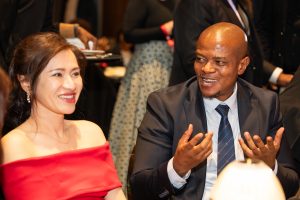
Christine Wu, interim co-chief executive personal and private banking at Absa having a conversation with SANEF chairperson Makhudu Sefara
The defence of media freedom is not cheap. Training, policy advocacy, research, and, most expensively, litigation, all require significant capital. SANEF should be unapologetic for seeking resources from all available avenues to ensure its survival and efficacy.
If the choice is between having a fully funded, legally capable SANEF that sometimes rubs shoulders with the powerful at a fundraising gala, or a pure, unblemished SANEF that is financially irrelevant and unable to protect a single journalist from a frivolous SLAPP suit, the choice for media freedom is clear. The former offers a practical shield, the latter, only an empty purist slogan.
Journalism’s integrity lies not in the purity of its financial ledger, but in the unflinching content published in the face of financial pressure. My understanding of SANEF’s mission is that it wants to ensure that journalists have the means to keep publishing that content, regardless of who bought a table at their gala dinner. That is a pragmatic defence of truth that warrants applause, not condemnation.
NB: Hopewell Radebe is the former City Press news editor and SANEF projects manager.
This website uses cookies to improve your experience while you navigate through the website. Out of these cookies, the cookies that are categorised as necessary are stored on your browser as they are essential for the basic functionalities of the website. We also use third-party cookies that help us analyse and understand how you use this website. These cookies will be stored in your browser only with your consent. You also have the option to opt-out of these cookies. Opting out of some of these cookies may have an effect on your browsing experience.
Necessary
Always active
Necessary cookies are essential for the website to function properly. This category only includes cookies that ensures basic functionalities and security features of the website. These cookies do not store any personal information.
Preferences
The technical storage or access is necessary for the legitimate purpose of storing preferences that are not requested by the subscriber or user.
Analytics
Analytics cookies are used to track user behaviour on our website. We process these cookies to understand user engagement and improve user experience on our website.The technical storage or access that is used exclusively for anonymous statistical purposes. Without a subpoena, voluntary compliance on the part of your Internet Service Provider, or additional records from a third party, information stored or retrieved for this purpose alone cannot usually be used to identify you.
Marketing
The technical storage or access is required to create user profiles to send advertising, or to track the user on a website or across several websites for similar marketing purposes.




 Media Viability and Freedom: Recognising that the media ecosystem faces an era defined by the financial crisis of journalism and mounting threats to media freedom, delegates called for G20 nations to take decisive steps toward establishing sustainable funding models for independent media that prioritise public interest journalism. They emphasised that the media’s viability “is not merely an economic issue; it is foundational to democratic health and preservation of free societies.”