Mapping information risks and mitigations for election integrity in 2026
Threats to journalists, especially women journalists, are a top Information risk in the upcoming local government elections, alongside the threat of an expected flurry of deepfakes.
These insights emerged from a brainstorm of 20 people at a meeting convened by SANEF and MOXII Africa (formerly Media Monitoring Africa) on 9 February, held at the SANEF offices in Johannesburg. The document can be accessed here.
The likelihood and severity of unfounded attacks on the IEC were also ranked as high risk by the participants, as was also the prospect of online and offline attacks and intimidation of officials exposing municipal corruption.
The workshop involved representatives from the IEC, media houses, one of the big tech companies, researchers and civil society support groups.
A similar human rights risk assessment was done ahead of the 2024 national government elections, providing the model in 2026 and feeding into the coalition activities of the UNESCO-supported Social Media For Peace SA (SM4P) programme, of which SANEF and MOXII are members.
The workshop pooled people’s insights into mapping what risks to information integrity could be expected in 2026 to pose a serious threat to election integrity. The group also proposed mitigations by both media and big tech. They identified three categories of threats:
Risks to expression – intimidation of the public and the media
Disinformation regarding voters’ access to information
Threats to the electoral process, such as attacks on the credibility of the IEC.
According to participants, amongst the ways that media people can help counter the risks are:
Building journalistic credibility by showing the public “how the news sausage is made”
Organising solidarity and specialised training for journalists, and reinforcing codes of conduct
Setting up a rapid response capacity to alert the public about deepfakes, such as impersonations of IEC officials
Working with researchers and civil society
Steps that tech platforms can take were also proposed. These are to:
Re-publicise and enforce their terms of service to remind users that incitement is forbidden conduct on these services
Detect election-related content that threatens information integrity, and moderate it accordingly
Support fact-checking
Be transparent about plans relating to election integrity and give researchers access to data.
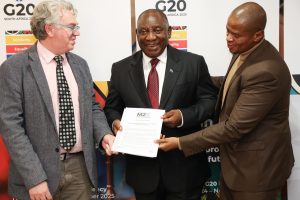
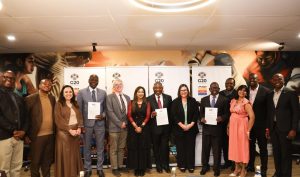
President Cyril Ramaphosa received the M20 Summit Declaration from MMA’s William Bird and SANEF Chairperson Makhudu Safara.
The leadership of the South African National Editors’ Forum (SANEF) and Media Monitoring Africa (MMA – (now called Moxii Africa)) met with President Cyril Ramaphosa on Tuesday afternoon to present the M20 Johannesburg Declaration, ahead of his meeting with G20 leaders on Saturday.
Makhudu Sefara, SANEF Chairperson, and William Bird, Director at MMA, explained to President Ramaphosa that the M20 Summit was organised against the backdrop of alarming threats to independent journalism, media viability, and an avalanche of physical and online harms. The summit also sought to uphold the rights of women and children and to prioritise information integrity for the public good.
President Ramaphosa expressed appreciation and support for the M20 Summit’s identification of critical elements recommended in its declaration, starting with the safety of journalists to address the global media landscape’s multifaceted challenges.
Key Elements of the M20 Johannesburg Declaration
The declaration outlines key areas for action by G20 nations:
Information Integrity: Facing a staggering increase in mis- and disinformation, the Summit stresses that independent media must reinforce the highest standards of journalistic ethics and develop robust mechanisms to uncover and counter disinformation campaigns, including those fuelled by Artificial Intelligence (AI). “Our integrity hinges on our commitment to deliver credible information to the public, particularly regarding climate sustainability and environmental protection,” the declaration states.
Safety of Journalists: The relentless persecution of journalists worldwide, “especially in war-torn Gaza,” must be condemned, with a call for an end to impunity for those who attack journalists during armed conflicts. The M20 stresses the urgency of solidarity in addressing not only physical violence but also the rising tide of online threats, “especially those targeting women journalists.” A global campaign must be initiated to demand justice for journalists whose lives and work are compromised by violence, intimidation, harassment and authoritarian repression.
Artificial Intelligence: The convergence of media and technology necessitates urgent dialogue on AI’s implications for journalism. The Summit advocates for ethical frameworks and policies that ensure fair compensation for journalists whose work feeds AI systems, alongside a commitment to transparency and accountability from technology companies in their usage of journalistic content. “This is especially vital for the Global South, where vulnerabilities in technology deployment are most pronounced.”
Media Viability and Freedom: Recognising that the media ecosystem faces an era defined by the financial crisis of journalism and mounting threats to media freedom, delegates called for G20 nations to take decisive steps toward establishing sustainable funding models for independent media that prioritise public interest journalism. They emphasised that the media’s viability “is not merely an economic issue; it is foundational to democratic health and preservation of free societies.”
Perspectives on the M20 and Media’s Role
Tshamano Makhadi, Deputy SANEF Chairperson, highlighted the historic nature of the event, noting that the M20’s Johannesburg Declaration will directly inform the G20 discussions.
“The summit marks a significant milestone in our nation’s history, not only as we become the first African nation to host such a pivotal meeting, but also for the South African media (the guardians of our democracy) to spearhead the M20 initiative, supported by over 80 South African and international organisations in shaping global policy especially on information integrity. These are the stories we will recount to our children and future generations,” Makhadi wrote in his social media account.
President Ramaphosa told the South African media that the M20 initiative was in itself a historic moment that was adding impetus to the story of South Africa’s achievements through the hosting of the G20.
“Where we go wrong, the media must be vocal, but where we do right, we want to hear the media to equally say yes … we are on the Global map and everybody is watching us,” he said.
He also stressed the media’s role in informing South Africans about the efforts that made the G20 events a success.
“Yes, we do have flaws like any country, it is an important historic moment when an African country which is laden with many problems and challenges is demonstrating that it can rise above them.”
The President also acknowledged the government was aware that the media sector was facing serious challenges of sustainability and survival, and that there was a need for government and media to engage constructively. He committed that his office would plan a constructive engagement on how the sector can continue operating in a safe environment.
“Our Constitution fully guarantees your freedom … as the government, much as sometimes you are the pain (somewhere), but one thing we will do, is to safeguard your freedom,” Ramaphosa said.
SANEF’s Western Cape convenor Prof Sisanda Nkoala carried the flag of the organisation, in moderating an expert panel on information integrity at the G20-linked AI for Africa conference in Cape Town on 1 October.
She recalled that the theme of information integrity was at the heart of the M20 summit organised by SANEF and MMA on September 2 and 3.
“Without information integrity at the core of our digital interactions, our societies and communities risk being manipulated and destabilised. In this era where we are flooded with content, the need to reassert the truth and trust for information integrity has never been more urgent,” said Prof Nkoala,
The panel assessed the seriousness of the threat of deepfakes to Africa, and covered how media and others are responding to it. Speakers noted that the official G20 Chair’s statements preceding the conference had acknowledged the contributions of the M20 to the G20 ministerial deliberations. Coincidentally, the week of the session saw former Finance Minister Trevor Manual actively dissociate himself after being deepfaked around scam investment advice.
Panelist, Churchill Otieno, Chair of the African Editors Forum, highlighted the problems of Generative AI impostering real journalists to scam the public. Quick response is needed to protect journalists who are victims of deepfakes, he said.
He told how African journalists are using AI tools to work more efficiently, such as in fact-checking but added that they needed time to pursue verification. The African Editors Forum, which includes SANEF, was urging members to label use of AI-generated content in order to promote trust, said Otieno.
Highlighting how news producers should respond to the fake online content, he argued: “Journalists should follow the mantra: they go low, we go high.”
Prof Herman Wasserman of the Centre for Information Integrity in Africa at the University of Stellenbosch reviewed the wider ecosystem of disinformation that includes less-sophisticated tools than deepfakes, with false content also circulating on WhatsApp, by word-of-mouth and in some media outlets.
He noted the problem of governments clamping down on free expression, and factors like social reluctance to correct elders or religious leaders, which exacerbate the sharing of false content.
Although deepfakes are currently just one part of disinformation, technology is moving fast, pointed out panelist Dr Victor Shale of South Africa’s Independent Electoral Commission.
Representing the 47-member Network of African National Human Rights Institutions, Dr Eileen Carter urged collaboration between policy-makers, media, civil society and the private sector, and outreach to grassroots people, to advance digital literacy and accountability. Whereas disinformation in some contexts was seen as a threat to individual privacy and autonomy, in Africa collective rights were at stake, she said.
Speaking from the audience, UNESCO’s Tawfik Jelassi said his organisation will convene a global conference on information integrity in Pretoria. He further signalled UNESCO’s Social Media 4 Peace project in South Africa in which SANEF is a participant.
SANEF TG Sbu Ngalwa openning the Media20ZA Summit.Pic: Dzudzie Netshisaulu
The Media20 Summit has taken advantage of the G20 Presidency of South Africa, which is providing a great opportunity to drive key initiatives across various sectors, to lobby world leaders to acknowledge critical media freedom, sustainability and safety of journalists.
Cas Coovadia, B20 Sherpa, addressed delegates, journalists, and changemakers attending the launch of the M20 Summit in Johannesburg on Sunday, 31 August 2025. He said the Summit was a rare space where media would sit at the heart of global progress. It was a chance to forge partnerships, not just between governments and journalists, but between business and truth. Between profit and principle.
“When journalists are empowered, when stories are told with integrity, and when Africa speaks for itself, the world listens.”
He said that for too long, Africa’s narrative had been distorted by external lenses. “The story of Africa,” he declared, “has too often been written by others, framed through deficit, disaster and dependency.”
He said the continent was rising, not waiting. And its ascent demanded empowered newsrooms free to investigate, bold enough to question, and imaginative enough to reframe the African narrative.
He said South Africa’s reckoning with state capture had not begun in Parliament, but in the newsroom. Journalists had followed the paper trails, decoded the emails, and exposed the rot. Their work led to commissions, accountability, and the first steps of national healing. “That is not just journalism,” Cas said. “That is nation-building.”
Coovadia, a lifelong advocate for truth, accountability, and inclusive growth, drew parallels to Brazil’s Operation Car Wash, saying investigative reporting toppled giants and reshaped politics. These stories, he insisted, were not anomalies; they were proof that the media, when free and capable, was a pillar of democracy.
He turned the lens on business, saying the business world cannot speak of inclusive growth while ignoring the role of the media in holding it accountable.
He said the investing principle that prioritises environmental issues, social issues, and corporate governance (ESG principles) would mean nothing if the institutions that ensured transparency were left to wither. Newsrooms needed investment, not just to survive, but to thrive. To train reporters, protect whistleblowers, and embrace digital security.
Dr Kirston Greenop, Head of Corporate Citizenship at Standard Bank Group, said there was no secret that the world of media was facing many existential threats, and the work of truth-telling was becoming highly contested and increasingly challenging.
She said that this year’s M20 Summit was aimed at positioning media integrity and sustainable journalism as critical components of the G20 agenda while reflecting on global conversations about interconnected challenges like sovereign debt and climate change, among others.
This is why Standard Bank welcomed the opportunity to play a small part in ensuring that this M20 Summit took place successfully.
Dr Greenop said that as Africa’s largest bank by assets, Standard Bank Group is actively involved in ensuring the success of the G20 Presidency.
“We are a Lead Sponsor in B20 South Africa, the business dialogue platform that supports the G20,” he said.
Although there was no silver bullet to solving the challenges the media faced globally, it was gatherings like the M20 Summit that reaffirmed the view that the media does not stand in isolation in working to address the challenges. After all, it was the global order that followed the end of WW2, built on the understanding that one hand washes the other, that showed that there was greater strength in ‘standing in unison’.
Welcoming guests to a banquet ahead of the M20 Summit, Heather Robertson, SANEF Gauteng co-convenor, described ethical journalists as an endangered species in an era of digital disinformation.
She explained that SANEF was formed in 1996 to unite media professionals committed to ethical journalism and media freedom. She highlighted the threats journalists face globally, including violence and job insecurity due to the collapse of traditional advertising models disrupted by digital platforms.
SANEF has proposed a Journalism Fund (JFSA) seeking R100 million to support public interest journalism, she said, also calling on business leaders to support media viability through advertising, corporate subscriptions, and corporate social investment. Quoting a recent research by Trialogue24, she said it found that out of R12.7 billion of Corporate Social Investment only 1% of it in South Africa currently goes toward media freedom initiatives to build a sustainable information ecosystem in the country’s Bill of Rights.
The M20 Summit will produce the Johannesburg M20 Declaration, urging G20 leaders to address the information integrity crisis. The speech encourages business support for media literacy programs to help citizens distinguish between real news and misinformation.
At the Media20 Summit in Johannesburg, South Africa’s Minister of Communications, Solly Malatsi, has emphasised the urgent need for global cooperation to uphold information integrity. Drawing from historical lessons, he recalled how a single photograph of Hector Pieterson during the Soweto uprising transformed global perceptions of apartheid in 1976, demonstrating the profound impact that truthful reporting can have on society.
“Information is not a luxury; it is a public good essential for societal progress,” Malatsi asserted. He laid bare the pivotal role that accurate information plays in democracy, stating that citizens rely on facts to make informed decisions and hold their leaders accountable. He warned against the dangers posed by disinformation, citing instances from the 2024 South African election campaign where generative AI was misused to create misleading deepfake videos. These instances serve as stark reminders of how digital technology can distort reality and manipulate public opinion.
Malatsi highlighted that the struggle for information integrity transcends national borders. “If lies spread faster than truth, the consequences could be catastrophic for democracies and social harmony,” he warned, emphasising that the integrity of information is the backbone of not only democratic governance but also economic stability. Markets depend on transparency and trust; when false information dominates the landscape, it disrupts financial systems and undermines investor confidence.
Yet, amidst the challenges, the minister expressed optimism. According to recent studies, the impact of AI-driven misinformation during the elections was blunted by robust media structures that championed facts over fabrications. However, he stressed the need for continuous vigilance and cooperation among stakeholders. “A free press is essential; it acts as society’s watchdog, ensuring accountability and progress,” he highlighted.
Malatsi also pointed to a global crisis of media viability, noting that many outlets struggle to survive financially, which threatens their role as truth-bearers. He urged collaborative efforts to create sustainable funding models for independent journalism.
As the summit progressed, Minister Malatsi called for enhanced platform accountability, urging social media companies to promote factual information over sensationalism. He advocated for responsible AI governance, cautioning against the weaponisation of technology that could hinder truth.
In closing, Malatsi underscored the importance of treating information as a public good, stating, “We will not allow the tools of progress to become weapons against truth.” He reiterated that collaborative efforts, informed policies, and the empowerment of independent media voices are crucial as South Africa leads the charge in G20 discussions on information integrity. His compelling vision for the future of media could ensure that information serves humanity and upholds the foundations of democracy for generations to come.
The South African National Editors’ Forum (SANEF) is concerned about the remarks made by ANC Secretary-General, Fikile Mbalula, alleging unethical conduct on the part of some journalists who cover the ANC and its leaders.
This week, Mbalula publicly attacked the media and accused unnamed journalists of being part of factions within the governing party and having an agenda against the ANC. Unfortunately, Mbalula did not provide any evidence or clarity on the instances that he was referring to.
South Africa’s journalists have, over the years, covered all political parties without any fear or favour, and as an organisation, we have always advocated for journalists to conduct themselves in an ethical, balanced, and unbiased manner. Ethics and balanced reporting are the cornerstone of journalism. This is not to say that journalists are without flaws or beyond criticism.
While Mbalula claims to support media freedom, his conduct is contrary to his stated claim. If anything, his comments have the potential to erode media freedom and further exacerbate the trust deficit that exists between the media and the broader public. Mbalula is not only a leader in the ANC but also in society, and so his words are not without consequences.
At a time when the media is actively working to challenge disinformation and misinformation, Mbalula’s accusation – that the media is behind the spread of disinformation and misinformation – is not helpful.
Also, Mbalula has not reached out to SANEF to raise any of the concerns that he has publicly stated, despite his call on the organisation to “act decisively to confront this creeping ethical rot.”
If there is any rot, SANEF is always willing to address such, but cannot do so if such has not been brought to our attention. We are an organisation rooted in the defence of media freedom and promoting the highest standards in journalism.
Journalists across the spectrum do utilise anonymous sources, and this is an age-old practice which is not about to end anytime soon. But the use of anonymous sources is done within the prescripts of the Press Code.
If Mbalula is not satisfied or has a complaint against the work of any journalist, then he is free to approach the Press Council of SA and/or the Broadcasting Complaints Commission of SA. These two reputable bodies are charged with the responsibility of adjudicating any complaints against the media by a member of the public, including politicians, without having to pay a cent.
SANEF is ready to meet with Mbalula and his colleagues in the ANC to address any ethical concerns that they may have. At the same time, we challenge Mbalula to report any instance of suspected criminal conduct by journalists to the relevant law enforcement agencies. As a former cabinet minister, we expect him to know which relevant law enforcement door to knock on.
As the South African media, we are aware we will not always agree with those we report about, but we are always ready and available to have difficult conversations.
Note to Editors:
The South African National Editors’ Forum (SANEF) is a non-profit organisation whose members are editors, senior journalists, and journalism trainers from all areas of South African media. We are committed to championing South Africa’s hard-won freedom of expression and promoting quality, ethics, and diversity in the South African media. We promote excellence in journalism by fighting for media freedom, writing policy submissions, research, and education and training programmes. SANEF is not a union.
On Saturday, 28 June in Johannesburg, the South African National Editors’ Forum (SANEF) held a non-elective Annual General Meeting that discussed various issues from training and development of journalists, mental wellness, the upcoming Media20 (M20) Summit, and the important role of the Press Council of SA. Also discussed was the long-awaited media engagement between President Cyril Ramaphosa and the broader media in South Africa.
Market and Digital Platforms Market Inquiry/ Competition Commission
The AGM noted the progress that the Competition Commission has made with the Media and Digital Platforms Market Inquiry (MDPMI) and is looking forward to seeing the final report, expected at the end of August. The AGM was unequivocal in its position that all media entities must be members of the Press Council and/or the Broadcasting Complaints Commission of SA. This has always been SANEF’s position, which abides by the ethical codes set out by these industry bodies.
With the Competition Commission favouring the establishment of a country fund to support journalism, SANEF reiterates its position that no media house should be considered for any possible funding if they do not defer to the guidance of these reputable industry bodies that uphold journalism standards and ethics.
Print and Digital Media Transformation Report
SANEF also noted the release, in June, of the Print and Digital Media Transformation report. While the report marks an important intervention, it however does not include the broadcast media in the country. The exclusion of the broadcast media is unfortunate and makes it difficult to engage with the report, as the entire media landscape – and not just print and digital reporting publications – is facing challenges of sustainability. SANEF is looking to further engage with the GCIS on the report. With regards to the report, SANEF welcomes and supports the recommendation that only those who belong to the Press Council and BCCSA must be considered for any funds intended for the revitalisation of the media in South Africa.
Presidency Engagement
The AGM noted the progressive meeting between SANEF leadership and Kenny Morolong, the deputy minister in the Presidency, following the organisation’s criticism of the government and the Presidency’s attitude towards the South African media.
The meeting was also briefed on the deputy minister’s feedback at a recent media engagement event which he had communicated SANEF’s call on President Cyril Ramaphosa to have a direct engagement with the broader South African media, as he last took questions from the media in 2020. The ball is now in the President’s court.
Training of Journalists
The AGM resolved that more funds need to be raised for the continuous training of journalists. The training should be on areas such as financial journalism, mental wellness, indigenous languages reporting, and other specialised beats such as health and education. An institution of higher learning will be sought, with the view of partnering to provide such training and improvement of skills in newsrooms, given the massive skills deficit in most newsrooms due to the well-documented sustainability challenges of the media sector.
Progress on the M20
SANEF and Media Monitoring Africa, through the support of partners such as Brand SA and Standard Bank, have made significant progress regarding the preparations for the Media 20 (M20). The M20 is an independent initiative by the media and involves a series of media events that will take place parallel to the G20.
An international media summit has been planned for September, and numerous international media organisations have come on board to support the M20 efforts in South Africa.
There will be several policy issue papers that will be released, and more information can be found at Home – Media20. The work continues to focus on areas such as the role of AI in journalism, intellectual property, children in the media, and information integrity.
The safety of journalists is also a topic for the M20.
Note to Editors:
The South African National Editors’ Forum (SANEF) is a non-profit organisation whose members are editors, senior journalists, and journalism trainers from all areas of South African media. We are committed to championing South Africa’s hard-won freedom of expression and promoting quality, ethics, and diversity in the South African media. We promote excellence in journalism by fighting for media freedom, writing policy submissions, research, and education and training programmes. SANEF is not a union.
A Continent in Transition, a Country at a Crossroads
South Africa’s place in the 2025 Reuters Institute Digital News Report reveals a nation navigating a shifting digital news ecosystem. Set against a global backdrop of declining trust in traditional media, the rise of influencer-driven content, and the disruption of AI technologies, South Africa reflects many of these challenges but also offers unique insights from the African continent.
In line with global trends, South African audiences are turning away from legacy news formats like print and broadcast and leaning into social media and video platforms for news. According to the report, 33% of South Africans use TikTok for news, and 42% rely on YouTube, among the highest on the continent. These figures place South Africa closer to countries like Kenya and Nigeria, where younger, mobile-first populations have bypassed traditional media entirely, and further from the digital restraint still seen in Western Europe.
The rise of social video signals not only a change in format but a shift in trust. Across South Africa, audiences report paying more attention to content from news creators and influencers than traditional journalists, especially on platforms like TikTok. This parallels the global trend of personality-led journalism, where individuals with large followings often outperform newsrooms in audience engagement.
Trust and Misinformation Worries
South Africa reflects the global anxiety over misinformation. 73% of respondents say they are concerned about their ability to discern true from false information online, on par with Nigeria and the United States, well above the global average of 58%. Online influencers and politicians are viewed as the primary sources of misleading content, highlighting both the power and potential peril of the influencer-news dynamic.
Despite this, traditional news brands and government sources remain the top go-to platforms for verifying facts. This suggests that, while social platforms are becoming the default gateway for news, established brands still carry a credibility advantage—albeit a shrinking one.
AI: Scepticism with Cautious Engagement
One of the most significant global findings of the 2025 report is the emergence of AI chatbots and summarisation tools as legitimate news sources. Although only 7% globally report using AI for news weekly, this figure jumps to 15% among under-25s. South Africa mirrors this cautious adoption, with audiences expressing concern over AI’s potential to reduce trust and transparency in journalism. While users appreciate AI’s ability to summarise stories or translate them into indigenous languages, a potentially powerful tool in South Africa’s multilingual media landscape, they remain wary of fully automated content.
The shift away from traditional media is not just about platforms but also about generational values. South Africa’s young, urban, mobile-first population increasingly prefers video over text. This is echoed in broader Global South trends, where reading-intensive formats are being eclipsed by short-form, visual content. However, this shift coincides with growing news fatigue. As in many other countries, a significant portion of South Africans now selectively avoid news, especially content perceived as negative, political, or overwhelming.
Comparisons with the Global North
South Africa’s digital news environment shares much with first-world counterparts in the types of disruption but differs in intensity and cause. Where Western nations are grappling with news fatigue due to overexposure and political fatigue, South Africa’s issues are compounded by data costs, digital literacy gaps, and declining newsroom resources.
While countries like Norway and the UK still enjoy relatively high rates of digital news subscriptions (42% and 9% respectively), only a small fraction of South Africans pay for online news. Free, mobile-accessible platforms dominate. This economic reality curtails the viability of subscription-driven models that have helped sustain journalism in the West.
Opportunities in Crisis
Yet, within these challenges lie opportunities. The South African data shows strong interest in local news, especially when delivered in accessible formats. There is also a tangible appetite for AI to enhance news relevance, accessibility, and language inclusion. These are potential areas for innovation and localisation that could serve not just South Africa but also offer a blueprint for the rest of the continent.
As the Digital News Report 2025 makes clear, South Africa is part of a new “social-first” global news ecosystem. It is a country where the old guard of journalism is being disrupted not just by technology, but by a generation that demands news on its own terms: fast, visual, interactive, and personalised. The question is not whether South Africa will follow global trends, but how creatively and inclusively it can chart its own path, the report concludes.
Chris Nissen SAHRC Chairperson: Pic; Malherbe Nienaber/Netwerk24
The South African Human Rights Commission (SAHRC) has called for stronger collaboration between the Commission and the media, emphasising their shared responsibility in protecting the public and monitoring the government.
“We stand together with the media,” Chris Nissen, SAHRC Chairperson, stated at the annual meeting between the SAHRC and the South African National Editors’ Forum (SANEF) on February 24, 2005. “The media plays a critical role in alerting the SAHRC to incidents that fall within our mandate to monitor, investigate, or promote as part of our human rights obligations.”
He highlighted the media’s essential function in disseminating information and knowledge to the public, enabling informed decision-making. He further underscored the Commission’s appreciation for its relationship with the media.
Nissen proposed that engagement between the SAHRC and the media should extend beyond formal meetings to include collaborative activities such as annual lectures, workshops, and seminars.
“We live in a country facing three significant challenges: inequality, poverty, and unemployment. As the Human Rights Commission, our concerns are closely tied to the socio-economic crisis. We urge the media to engage with us as partners while also supporting our broader mission to build a better South Africa. Together, we can uphold human rights and responsibilities.”
He also stressed the importance of maintaining the independence of both institutions while exploring opportunities for cooperation.
“We can collaborate on various programs while respecting each other’s independence. You are independent. We are independent. But we can work together even when our opinions differ,” he said.
During the meeting, SAHRC commissioners shared details about their respective portfolios and the provinces where they are stationed. SANEF, in turn, outlined its 2025 program of action, highlighting plans for voter education training for journalists ahead of the 2026 local government elections. This initiative aims to equip journalists with the knowledge they need to inform the public effectively.
The commissioners expressed their gratitude to the media for its accurate and fair reporting on the Commission’s investigative inquiries in Mpumalanga and the Free State. They also commended the media’s balanced coverage of discussions between the Commission and various government ministers, including those responsible for Water and Sanitation, Cooperative Governance, and engagements with the Parliamentary Portfolio Committee on Water and Sanitation.
The Commission acknowledged that media coverage had significantly enhanced its visibility and reach within communities, ensuring broader awareness of its work.
SANEF used the opportunity to raise concerns about the challenges journalists face, particularly cyberbullying and harassment, with female journalists often being targeted. The organisation also highlighted the intimidation — both direct and indirect — that journalists endure, especially during political campaign seasons.
The SAHRC acknowledged these concerns, noting the increasing use of Strategic Lawsuits Against Public Participation (SLAPPs) to intimidate journalists and suppress legitimate reporting.
“It is troubling that legal mechanisms are being misused to hinder investigative journalism,” Nissen remarked. “Such tactics falsely portray journalism as harassment to silence critical reporting.”
He revealed that the Commission had discussed this issue at its recent Senate meeting and committed to supporting the media fraternity. The SAHRC pledged to issue statements in defense of journalists facing harassment and expressed interest in tackling misinformation and disinformation, another key area of concern for the media.
Additionally, the Commission committed to continuing its visits to newsrooms, fostering open discussions with journalists and editors in their work environments to better understand their challenges and concerns.
This website uses cookies to improve your experience while you navigate through the website. Out of these cookies, the cookies that are categorised as necessary are stored on your browser as they are essential for the basic functionalities of the website. We also use third-party cookies that help us analyse and understand how you use this website. These cookies will be stored in your browser only with your consent. You also have the option to opt-out of these cookies. Opting out of some of these cookies may have an effect on your browsing experience.
Necessary
Always active
Necessary cookies are essential for the website to function properly. This category only includes cookies that ensures basic functionalities and security features of the website. These cookies do not store any personal information.
Preferences
The technical storage or access is necessary for the legitimate purpose of storing preferences that are not requested by the subscriber or user.
Analytics
Analytics cookies are used to track user behaviour on our website. We process these cookies to understand user engagement and improve user experience on our website.The technical storage or access that is used exclusively for anonymous statistical purposes. Without a subpoena, voluntary compliance on the part of your Internet Service Provider, or additional records from a third party, information stored or retrieved for this purpose alone cannot usually be used to identify you.
Marketing
The technical storage or access is required to create user profiles to send advertising, or to track the user on a website or across several websites for similar marketing purposes.


 Media Viability and Freedom: Recognising that the media ecosystem faces an era defined by the financial crisis of journalism and mounting threats to media freedom, delegates called for G20 nations to take decisive steps toward establishing sustainable funding models for independent media that prioritise public interest journalism. They emphasised that the media’s viability “is not merely an economic issue; it is foundational to democratic health and preservation of free societies.”