Media Leaders Present M20 Declaration to President Ramaphosa Ahead of G20
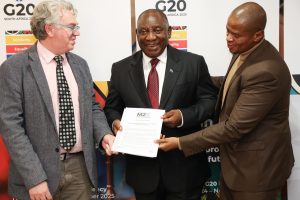
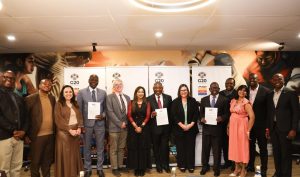
The leadership of the South African National Editors’ Forum (SANEF) and Media Monitoring Africa (MMA – (now called Moxii Africa)) met with President Cyril Ramaphosa on Tuesday afternoon to present the M20 Johannesburg Declaration, ahead of his meeting with G20 leaders on Saturday.
Makhudu Sefara, SANEF Chairperson, and William Bird, Director at MMA, explained to President Ramaphosa that the M20 Summit was organised against the backdrop of alarming threats to independent journalism, media viability, and an avalanche of physical and online harms. The summit also sought to uphold the rights of women and children and to prioritise information integrity for the public good.
President Ramaphosa expressed appreciation and support for the M20 Summit’s identification of critical elements recommended in its declaration, starting with the safety of journalists to address the global media landscape’s multifaceted challenges.
Key Elements of the M20 Johannesburg Declaration
The declaration outlines key areas for action by G20 nations:
Information Integrity: Facing a staggering increase in mis- and disinformation, the Summit stresses that independent media must reinforce the highest standards of journalistic ethics and develop robust mechanisms to uncover and counter disinformation campaigns, including those fuelled by Artificial Intelligence (AI). “Our integrity hinges on our commitment to deliver credible information to the public, particularly regarding climate sustainability and environmental protection,” the declaration states.
Safety of Journalists: The relentless persecution of journalists worldwide, “especially in war-torn Gaza,” must be condemned, with a call for an end to impunity for those who attack journalists during armed conflicts. The M20 stresses the urgency of solidarity in addressing not only physical violence but also the rising tide of online threats, “especially those targeting women journalists.” A global campaign must be initiated to demand justice for journalists whose lives and work are compromised by violence, intimidation, harassment and authoritarian repression.
Artificial Intelligence: The convergence of media and technology necessitates urgent dialogue on AI’s implications for journalism. The Summit advocates for ethical frameworks and policies that ensure fair compensation for journalists whose work feeds AI systems, alongside a commitment to transparency and accountability from technology companies in their usage of journalistic content. “This is especially vital for the Global South, where vulnerabilities in technology deployment are most pronounced.”
 Media Viability and Freedom: Recognising that the media ecosystem faces an era defined by the financial crisis of journalism and mounting threats to media freedom, delegates called for G20 nations to take decisive steps toward establishing sustainable funding models for independent media that prioritise public interest journalism. They emphasised that the media’s viability “is not merely an economic issue; it is foundational to democratic health and preservation of free societies.”
Perspectives on the M20 and Media’s Role
Tshamano Makhadi, Deputy SANEF Chairperson, highlighted the historic nature of the event, noting that the M20’s Johannesburg Declaration will directly inform the G20 discussions.
“The summit marks a significant milestone in our nation’s history, not only as we become the first African nation to host such a pivotal meeting, but also for the South African media (the guardians of our democracy) to spearhead the M20 initiative, supported by over 80 South African and international organisations in shaping global policy especially on information integrity. These are the stories we will recount to our children and future generations,” Makhadi wrote in his social media account.
President Ramaphosa told the South African media that the M20 initiative was in itself a historic moment that was adding impetus to the story of South Africa’s achievements through the hosting of the G20.
“Where we go wrong, the media must be vocal, but where we do right, we want to hear the media to equally say yes … we are on the Global map and everybody is watching us,” he said.
He also stressed the media’s role in informing South Africans about the efforts that made the G20 events a success.
“Yes, we do have flaws like any country, it is an important historic moment when an African country which is laden with many problems and challenges is demonstrating that it can rise above them.”
The President also acknowledged the government was aware that the media sector was facing serious challenges of sustainability and survival, and that there was a need for government and media to engage constructively. He committed that his office would plan a constructive engagement on how the sector can continue operating in a safe environment.
“Our Constitution fully guarantees your freedom … as the government, much as sometimes you are the pain (somewhere), but one thing we will do, is to safeguard your freedom,” Ramaphosa said.
ENDS