
The IEC’s Inaugural Symposium Assesses South Africa’s Political Funding Landscape Four Years On
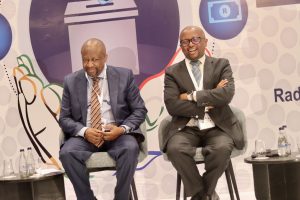
Picture supplied by IEC.
The Electoral Commission of South Africa (IEC) is hosting a groundbreaking symposium on political funding in South Africa in uMhlanga, KwaZulu-Natal, aimed at evaluating, reflecting on, and strategising on funding political activity in the country.
The symposium takes place four years after the implementation of the Political Party Funding Act (PPFA) of 2018, which was amended and renamed the Political Funding Act (PFA) in 2024 to include independent candidates. This legislative evolution reflects a broader commitment to promoting transparency, accountability, and integrity in South Africa’s democratic processes.
It brings together a wide range of stakeholders, including political party leaders, Members of Parliament, civil society organisations, business leaders, and members of the media including SANEF and the Press Council South Africa, creating a unique space for inclusive dialogue.
In his opening remarks, IEC Chairperson Mosotho Moepya described the gathering as “a pivotal moment in the ongoing efforts to strengthen democratic governance and electoral integrity.” He emphasised that the Act was “a deliberate and bold commitment to enhancing transparency, fairness, and accountability” and underscored that inclusive, multi-stakeholder engagement. This was essential to ensuring the credibility and legitimacy of any future reforms.
“This symposium reflects a fundamental commitment to inclusive governance,” Moepya said, “where the health and integrity of our democracy are recognised as a shared responsibility.”
Reflecting with Purpose, Not Rhetoric
IEC Chief Electoral Officer Sy Mamabolo echoed these sentiments, describing the adoption of the Act as “a milestone in our collective effort to bring greater transparency to political financing.”
Framing the symposium as a moment for honest appraisal rather than celebration, Mamabolo posed a series of critical questions: “Has the law delivered on its promise? Has it safeguarded our democracy? Has it enabled, rather than hindered, the healthy competition of ideas in the political marketplace?”
He called on all participants, regardless of ideology, to seize this opportunity to strengthen the legislation: “No political ambition should rest on secret money, undue influence, or inequitable advantage.”
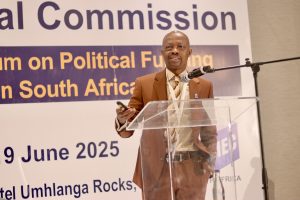
A highlight of the symposium was a presentation by IEC Deputy CEO George Mahlangu, who provided a comprehensive overview of the PFA’s implementation, outlining achievements and ongoing hurdles.
Key Gains Under the Political Funding Act
- Greater Transparency and Public Awareness
The regular publication of donation reports has boosted public trust and accountability. The IEC’s quarterly disclosures of political donations have empowered voters with insights into “who funds whom.” While public understanding of the Act remains limited, awareness is gradually growing. - Stronger Regulatory and Institutional Framework
The PFA has introduced clear rules on political finance and donor behaviour. The IEC has developed new systems, including the Online Political Funding System (OPFS), and built internal capacity through training. The Commission’s powers to enforce compliance, through fines and legal recourse, have been significantly enhanced. - Improved Compliance and Sound Financial Management
Most represented political parties now meet disclosure requirements. The IEC itself has received three consecutive clean audit outcomes from the Auditor-General, with a fourth currently underway. Even some unrepresented parties have begun submitting audited statements, suggesting a broader culture of accountability is taking root.
Persistent Challenges
Despite meaningful progress, several challenges persist:
- Limited Public Awareness
Awareness of the Act among the general public remains low, leading to misconceptions and misplaced expectations—such as calls for investigations when legal thresholds are not met. This knowledge gap weakens public oversight and undermines the Act’s goals. - Uneven Compliance, Especially by Unrepresented Parties
While compliance is relatively strong among parties represented in Parliament, some only disclose funds late in the financial year. Compliance among unrepresented political parties remains critically low, skewing the level playing field and introducing opacity into parts of the political system. - Resource Constraints and Legal Loopholes
Many smaller or unrepresented parties lack the resources to comply fully. Mahlangu also flagged legal loopholes, particularly around anonymous donations and foreign contributions. Although foreign governments are barred from donating, foreign entities may still contribute up to R5 million, earmarked for policy and training, raising concerns about potential backdoor influence.
Charting the Way Forward
The symposium affirms South Africa’s resolve to build a more accountable political funding system. While major strides have been made, challenges such as public engagement, uneven compliance, financial inequity, and regulatory loopholes require urgent and sustained attention.
The focus remains on sharpening the implementation of the Political Funding Act and ensuring it lives up to its founding promise: to guard the democratic space from corruption, secrecy, and undue influence.
Ends