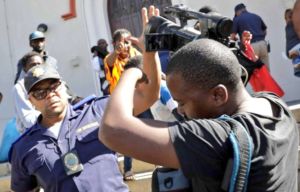
On Thursday 23 July the South African National Editors’ Forum (SANEF) and the South African Police Services (SAPS) management held a robust, frank and successful meeting on a wide range of issues, including the working relations between journalists and members of the police.
The SANEF delegation, led by Deputy Chair Katy Katapodis, met the SAPS delegation, led by National Police Commissioner General Khehla John Sitole. SANEF tabled concerns regarding the hindrance and harassment of journalists in courts around the country as well as the media’s experiences of harassment and injury by SAPS members while in the field covering the Coronavirus crisis.
In turn, SAPS tabled concerns regarding some members of the media obstructing police in their course of duty. Further, they outlined their new Online Policing Strategy to fight crime online. The details will be released at the later stage.
The meeting agreed that despite specific serious incidents, the relationship between journalists and the various units of the SAPS was primarily mutually cordial, reflecting the spirit of cooperation between the media and the SAPS. The meeting agreed that this showed that both journalists and police officers can do their jobs without confrontation and that it is possible for both parties to respect their various roles out in the field.
Further, the meeting decided to recommit to the Memorandum of Understanding, which was signed more than 10 years ago but is still relevant. It was agreed that this document needed to be updated and made relevant to the current times, before being signed by September.
To take this work further, the meeting agreed to establish a team with representatives from both SAPS and SANEF to unpack the Memorandum of Understanding. It will recommend a programme of action that includes training for journalists on crime scene etiquette and training for police officers on the critical role of the media in covering crime and protests.
Note to Editors: The South African National Editors’ Forum (SANEF) is a non-profit organisation whose members are editors, senior journalists and journalism trainers from all areas of the South African media. We are committed to championing South Africa’s hard-won freedom of expression and promoting quality, ethics and diversity in the South African media. We promote excellence in journalism through fighting for media freedom, writing policy submissions, research and education and training programmes. SANEF is not a union.
The South African National Editors’ Forum (SANEF) condemns the threats made against a correspondent journalist working on a story for the Zoutpansberger and Limpopo Mirror.
The community newspapers in Limpopo have been investigating a story on the National Lotteries Commission’s funding of a non-profit organisation, Vyeboom Youth Development in the province.
According to Anton van Zyl, publisher of the Zoutpansberger and Limpopo Mirror, their correspondent received a threatening phone call on Thursday 23 July 2020 from a person telling him to stop enquiring about the activities at the project. He was told that if he did not stop, he would be followed and hurt.
Van Zyl said the correspondent had made enquiries requesting information about the non-profit which has received at least R15 million from the National Lotteries Commission (NLC) in the past few years. He said the matter was reported to the local police and a case of intimidation is being investigated.
“We don’t take kindly to such threats to our journalists, and we view it as a direct attack on media freedom and the constitutional values that we hold dear. The only way we can effectively respond to such threats is to shine a light on what is happening and try and establish why people would want to hide the truth,” Van Zyl said.
SANEF believes it is inexcusable for individuals to threaten the journalist. We trust that the police will give this matter the urgency it deserves and identify the culprits.
Further, SANEF is disturbed by the reluctance of the National Lotteries Commission to release information about NPOs that it is funding despite the Minister of Trade and Industry, Ebrahim Patel’s clear statement in reply to a Parliamentary question last month that the NLC must make the list of non-profit organisations that it funds available.
For 18 years, the NLC has published these and other details on projects it funds as part of its annual reports. But last year it did an about-turn and excluded this information from its 2018-19 report.
SANEF and Media Monitoring Africa (MMA) are proceeding with a court application which challenges the constitutionality of Regulation 8 of the Lotteries Act to ensure that it is either set aside in its entirety or amended to bring it in line with the Constitution. Regulation 8 limits the disclosure of information on grant applications and grants themselves. Regulation 8(3) renders any person who discloses and publishes such information guilty of a criminal offence. This prohibition extends even to situations in which the disclosure or publication of information would be in the public interest – for instance, in order to bring to light allegations of corruption or maladministration regarding the manner in which public funds are being spent.
Our legal counsel is of the view that the current wording of Regulation 8 is an unjustifiable limitation on the right to freedom of expression, and that journalists are at risk of facing future litigation or criminal complaints from the NLC. The broad aim of the legal challenge is to shield news publications and journalists, who may want to publish NLC grant information in future, from being subject to litigation or criminal complaints.
Note to Editors: The South African National Editors’ Forum (SANEF) is a non-profit organisation whose members are editors, senior journalists and journalism trainers from all areas of the South African media. We are committed to championing South Africa’s hard-won freedom of expression and promoting quality, ethics and diversity in the South African media. We promote excellence in journalism through fighting for media freedom, writing policy submissions, research and education and training programmes. SANEF is not a union.
Death, arrest and attack, these are some of the challenges facing journalists on the continent and around the world. In South Africa, the Covid-19 pandemic has accelerated the closure of several media houses and left hundreds of journalists without jobs. We need to protect the rights and livelihoods of journalists given their critical role on the frontline.
I’m not very active on social media, but this week, as I scanned my Twitter timeline, I saw that there were more posts about journalists under threat than usual. First, I noticed the numerous updates, messages and support for Zimbawean journalist Hopewell Chin’ono, who’d been arrested on 20 July and charged with inciting public violence. Chin’ono had reported on irregularities in Covid-19 procurement processes, which resulted in the sacking of Zimbabwe’s Health Minister earlier this month. In addition, Chin’ono had shared calls for participation in protests against corruption planned for 31 July.
On Wednesday, Chin’ono was escorted into court in chains. He was not asked to enter a plea and his bail application was postponed by 24 hours – ostensibly due to a Covid-19 curfew. Jacob Ngarivhume, leader of the Transform Zimbabwe political party and organiser of the protests, appeared alongside Chin’ono and had also had his bail decision postponed. On Thursday, Ngarivhume’s bail request was denied, while Chin’ono’s bail decision was deferred until Friday.
Maria Ressa from the Philippines is another journalist facing spurious court charges. Ressa is a founder and the CEO of Philippines news site Rappler, known for its unflinching scrutiny of Filipino President Rodrigo Duterte. Amongst her accolades, Ressa was one of four journalists collectively called “the guardians of truth”, who were named by Time Magazine as Person of the Year in 2018. Ressa’s current court case is not her first – last month she was convicted of libel by a Manilla court and sentenced to a six-year prison term. She is currently out on bail and has pled not guilty to this latest charge of tax evasion.
Just last week, I read about the death of Mohamed Mounir, an Egyptian journalist who’d been arrested on 15 June 2015 and charged with spreading fake news, joining a terrorist organisation and misusing social media. According to the International Federation of Journalists (IFJ), the accusation of spreading fake news stemmed from Mounir’s “openly critical stance towards the [Egyptian] government’s response to the Covid-19 pandemic.” Mounir worked for Al Jazeera, which is banned in Egypt, while the charges of misusing social media related to sharing a surveillance video on Facebook of armed policemen visiting his home a few days before his arrest.
Mounir, who was 65-years old, contracted Covid-19 in Cairo’s Tora Prison, or possibly when he was taken to Tora Linman Hospital, where many coronavirus cases are treated. Mounir was released from prison on 2 July and died days later on 13 July – from what Palestinian presenter Farah al-Barqawi called “murder by coronavirus”. Mounir was not the only Egyptian journalist to be jailed and denied due legal process. At the time of his death, the IFJ estimated that there were at least 37 journalists in Egypt’s jails.
Then, there’s the case of Paul Nthoba, the South African journalist who fled to Lesotho in May after being assaulted by police in Ficksburg, Free State in May after he filmed them enforcing the Covid-19 lockdown and the awful experience of News24 journalist Jenni Evans who had rocks thrown at her car and her phone stolen when she was covering protests in Khayelitsha this week.
A free press is a critical bulwark against autocracy. We must protect journalists’ rights to safety and security. The Covid-19 pandemic has proven that the media is an essential service – at a time when their livelihoods are being eroded most rapidly.
South Africa’s independent media has been in peril for a number of years due to dwindling advertising revenue and the dominance of platforms like Google and Facebook. For many media workers, Covid-19 has been the final knell.
Earlier this month, Kate Skinner, Executive Director of SANEF – the South African National Editors’ Forum, spoke about the more than 700 journalists who’d lost their jobs as a direct result of Covid-19. When we heard about the fund that SANEF had started to provide assistance to those affected, we felt compelled to help. We are pleased that OSF-SA has been able to contribute R500 000 to the SANEF Media Relief Fund as part of our Covid-19 response.
We’ve also begun conversations with our other media partners to find out how Covid-19 has impacted their work. This is part of the listening campaign we embarked on this month as we finalise our new strategy.
Over four meetings and with approximately 200 attendees, I’ve personally learned so much about the work you do, the communities you serve and the difference you seek to make in the world. I appreciate the emails and insights you’ve provided as we think about the changes we need and want to see in South Africa and the world in the next few years and into the future.
The South African National Editors’ Forum (SANEF) stands in solidarity with calls for the release of investigative journalist, Hopewell Chin’ono, who was arrested and taken from his home in Harare on the 20th of July, 2020.
Press freedom and human rights organizations have written a letter to African Union Chair and the President of the Republic of South Africa, Cyril Ramaphosa.
The letter also calls for the guarantee that journalists across the continent are respected as essential workers throughout the COVID-19 pandemic and are not jailed for their work.
The South African National Editors’ Forum (SANEF) welcomes the launch of the SABC’s editorial policies including the corporation’s commitment to resolving the controversy around the position of editor-in-chief. We welcome the resolution of this issue and the clarification that editorial decision making now rests with the Head of News and that this post is now officially designated as editor-in-chief.
We believe that this decision is critical to ensuring the independence of the SABC as it limits the possibilities of outside interference.
Further, we welcome a number of other important amendments to the policies including:
The introduction of the Press Code to guide digital publishing; and
The introduction of a new section on management of content on digital platforms.
We note the SABC’s statement that the rationale behind the amendments is to strengthen editorial controls by ensuring that, “editorial staff take full accountability for editorial decisions”. Further, we note the SABC Board’s statement that, “Consistent with the ethos of the SABC Charter, the policies give an exclusive right to the editorial staff of the SABC, to exercise journalistic, programming and creative independence.” We welcome these statements as we believe that editorial decision making must rest with journalists.
Note to Editors: The South African National Editors’ Forum (SANEF) is a non-profit organisation whose members are editors, senior journalists and journalism trainers from all areas of the South African media. We are committed to championing South Africa’s hard-won freedom of expression and promoting quality, ethics and diversity in the South African media. We promote excellence in journalism through fighting for media freedom, writing policy submissions, research and education and training programmes. SANEF is not a union.
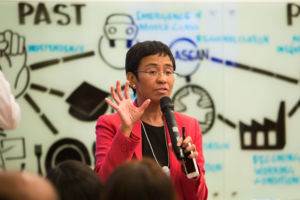
Maria Ressa, Executive Editor and Chief Executive Officer, Rappler.com, The Philippines. Photo by Sikarin Thanachaiary
The South African National Editors’ Forum joins leading editors, media executives, and media freedom advocacy groups around the world in calling on the Philippine authorities to end their campaign of harassment and intimidation of fellow journalist Maria Ressa.
A court in the Philippines yesterday (Monday 15 June 2020) found journalist Maria Ressa, the executive editor of the news website Rappler, and former Rappler reporter Reynaldo Santos Jr guilty of “cyber libel”, in a controversial case seen as a significant test of press freedom under the administration of President Rodrigo Duterte.
The court sentenced the pair to a minimum of six months and one day – to a maximum of six years in jail. It allowed them to post bail, pending an appeal. They are the first two journalists in the Philippines to be convicted for cyber libel.
SANEF condemns in the strongest terms the conviction which amounts to a blow to media freedom in the Philippines. We find it ironic that the presiding judge Raineldo Estocio-Montesa convicted the journalists shamelessly quoting former president Nelson Mandela saying: “to be free is not merely to cast off one’s chains but to live in a way that respects and enhances the freedom of others.”
SANEF wishes to remind judge Estocio-Montesa and the Philippines authorities that Mandela did not only advocate for media freedom; he ensured that it thrived even when it was critical of him.
He told the International Press Institute Congress on 14 February 1994 in Cape Town: “A critical, independent and investigative press is the lifeblood of any democracy. The press must be free from state interference. It must have the economic strength to stand up to the blandishments of government officials. It must have sufficient independence from vested interests to be bold and inquiring without fear or favour. It must enjoy the protection of the constitution so that it can protect our rights as citizens. It is only such a free press that can temper the appetite of any government to amass power at the expense of the citizen.”
SANEF believes that the cases filed against Maria Ressa, the founder and editor of the online news site Rappler, were a transparent attempt to silence her and shut down Rappler in retaliation for its critical coverage of President Rodrigo Duterte and his administration.
In solidarity with the media freedom advocacy groups around the world, SANEF regards the conviction of Rappler as part of a more massive assault on press freedom in The Philippines under President Duterte. The Duterte administration’s actions against the media gravely violate the fundamental rights to press freedom and freedom of expression and undermine the Philippine public’s right to access and receive independent news and information.
Shawn Crispin, the Committee to Protect Journalists CPJ’s senior Southeast Asia representative, said: “We call on the Philippine authorities not to contest Maria Ressa and Reynaldo Santos’ appeals. And to stop their campaign of legal harassment against Rappler and other independent media outlets. The criminal prosecution of journalists for their work has no place in a country that purports to be a democracy.”
We also vehemently condemn the vicious online attacks and smear campaigns against Maria Ressa and other journalists at Rappler, which are a further attempt to bully them into silence and deliberately undermine their credibility. These attacks are unacceptable and unworthy of a democratic society.
We call on the Philippine authorities to drop all other charges against Ressa and Rappler, ensure that all attacks – online and offline – against journalists are investigated and stop all forms of harassment and intimidation against the media
Note to Editors: The South African National Editors’ Forum (SANEF) is a non-profit organisation whose members are editors, senior journalists and journalism trainers from all areas of the South African media. We are committed to championing South Africa’s hard-won freedom of expression and promoting quality, ethics and diversity in the South African media. We promote excellence in journalism through fighting for media freedom, writing policy submissions, research and education and training programmes. SANEF is not a union.
The South African National Editors’ Forum (SANEF) welcomes the news that President Cyril Ramaphosa has taken steps to have the controversial and draconian ‘’Secrecy Bill” reviewed and aligned with the Constitution.
SANEF ‘s key concern throughout has been the lack of a public interest defence – and this review will now allow for this provision to be introduced.
The Protection of State Information Bill has remained unsigned for seven years after it was passed by Parliament following numerous submissions and acrimonious debate. The Bill sought to replace the notorious, Public Information Act of 1982.
Throughout the years SANEF has joined forces with a number of media freedom groups and activists to raise awareness about the unconstitutional nature of many parts of the Bill. Further, we have made a number of submissions to Parliament. One of the most draconian aspects of the present Bill, for instance, includes a 15 to 25-year jail term for any journalist found to have ‘’classified” documents in their possession.
SANEF welcomes this opportunity to ensure that all aspects of the Bill that are unconstitutional, or too broadly defined, are redrafted – and we would be happy to give further input to finalise it.
Note to Editors: The South African National Editors’ Forum (SANEF) is a non-profit organisation whose members are editors, senior journalists and journalism trainers from all areas of the South African media. We are committed to championing South Africa’s hard-won freedom of expression and promoting quality, ethics and diversity in the South African media. We promote excellence in journalism through fighting for media freedom, writing policy submissions, research and education and training programmes. SANEF is not a union.
The South African National Editors’ Forum (SANEF) condemns the death in detention of Cameroonian journalist, Samuel Wazizi and the ongoing attacks on journalists in the USA and UK.
In the US the Committee to Protect Journalists (CPJ) has noted over 300 media freedom violations since 26 May 2020 where reporters and camera operators have been punched or hit or their equipment damaged as they covered the protests against the murder of George Floyd. SANEF notes that journalists have been beaten, pepper-sprayed and arrested by police in numbers never documented in the US before. In the UK, a journalist was treated for head injuries in Westminster after protests got violent in London on 3 June 2020.
Courtney Radsch, advocacy director at the CPJ, states that what sets the past few days apart in the US, was the targeting of journalists by law enforcement agencies, even after they had identified themselves as members of the press. Some protesters and groups of “vigilantes” committed some of the violence wielding bats. This was according to the US Press Freedom Tracker, a non-partisan website of which the CPJ is a founding partner.
In terms of Cameroon, SANEF joins The African Editors Forum (TAEF) and CPJ in expressing dismay as regards the fact that the Cameroonian Defence Force, in whose hands Wazizi died, kept his death a secret and did not inform his family.
According to CPJ, Wazizi disappeared 10 months ago after he was taken by the police who then later handed him over to the Cameroon Defence Force. The Cameroonian Ministry of Defence stated on 5 June 2020, disclosing that Wazizi had allegedly died of sepsis on 17 August 2019. The family was only told on 3 June 2020.
SANEF calls on the President of Cameroon Paul Biya as well as the African Union to launch an independent investigation into the death of Wazizi and the subsequent cover-up by the army.
SANEF supports the remarks made by TAEF Chairperson, Jovial Rantao. Rantao stated, “The time has arrived for the harassment, intimidation and killing of journalists by members of the Cameroonian Defence Force to come to an end. These acts of crime visited upon journalists just for doing their work are reprehensible, and those responsible must face the full wrath of the law. We demand justice for Samuel Wazizi.”
Further, we support the statements made by Angela Quintal, CPJ’s Africa Programme Coordinator. She stated that “It is unbelievable that authorities covered up his death in custody for ten months despite repeated inquiries from press freedom advocates and his family, colleagues, friends, and lawyers”. She stated, “An independent autopsy should be conducted immediately, and Cameroon must also launch an independent commission of inquiry so that those responsible for Wazizi’s death are held accountable.”
CPJ has explained that Wazizi is the second journalist to die in custody in Cameroon over the last decade. In 2010 journalist Bibi Ngota died in Kondengui prison. His death certificate cited the cause of his death as a lack of medical attention while in detention. CPJ has confirmed that are seven journalists in jail in Cameroon.
SANEF would like to add its voice in calling on the government of Cameroon to immediately release journalists that are being held for their professional activities. We also call on African states to adhere to the UN Plan of Action on the Safety of Journalists, which calls on countries to develop legislation and mechanisms favourable to freedom of expression and information. The African Union should also actively promote media freedom on the continent, in line with Article 19 of the Universal Declaration on Human Rights and other protocols.
Note to Editors: The South African National Editors’ Forum (SANEF) is a non-profit organisation whose members are editors, senior journalists and journalism trainers from all areas of the South African media. We are committed to championing South Africa’s hard-won freedom of expression and promoting quality, ethics and diversity in the South African media. We promote excellence in journalism through fighting for media freedom, writing policy submissions, research and education and training programmes. SANEF is not a union.
Cape Town Metro Police officer barring a journalist from covering the eviction of refugees the Central Methodist Mission on Greenmarket Square. Pic: Unknown
In response to the Judge H Fabricius’ judgement handed down in the matter of Mr Collins Khosa on Friday, 15 May 2020, in the North Gauteng (Pretoria) High Court of South Africa, the South African Police Service (SAPS) has through its National Service Complaints Centre created a platform enabling the public and the media to report allegations of police brutality or cruelty, inhumane and/or degrading treatment and/or punishment, committed by members of the SAPS.
The public may, for the duration of the State of Disaster, report complaints regarding the SAPS at the nearest police station, the National Service Complaints Centre on the toll-free number 0800 333 177 or on the following email addresses
Complaints can vary from torture and/or cruel, inhumane, and/or degrading treatment and/or punishment, committed by law enforcement members including poor service delivery regarding police response, investigations, police negligence and police misconduct.
When you report a complaint, the respective complaint will be required to contain detailed information such as full names and surname, identity number, residential/business address, telephone and cell phone numbers and an email address.
Complainants will also be required to give a detailed description of what occurred during the incident including the province/area in which the complaint originates as well as the date and time of the incident and details of the SAPS officials involved.
The national state of disaster has created an unprecedented situation which requires the co-operation of everyone to prevent, limit, contain, combat and manage the spreading of COVID-19. Law enforcement agencies are expected to ensure that the disaster management regulations are adhered to by all inhabitants of the country.
Regulations and Directions are available at http://www.saps.gov.za/newsroom/ regulations/regulations.php
Members of the public suspected to be in contravention of the disaster management regulations may expect the following to happen:
– Be arrested or requested to accompany a law enforcement officer to a police station;
– If the offence is of a serious nature, the person may be detained, subject hereto that he or she must be brought before a court as soon as reasonably possible, but no later than 48 hours after the arrest.;
– The person may apply for bail at his or her appearance in court;
– If the offence is less serious, the community service centre commander or the senior member of the SAPS in charge must consider the release of a person (in consultation with the investigating officer) ─
(a) on a written warning to appear in court (section 72 of the Criminal Procedure Act, 1977) [Form SAPS 496 will be issued with a court date];
(b) on written notice (section 56 of the Criminal Procedure Act, 1977) (Form J 534 will be issued with an option to pay a fine or appear in court on the date indicated on the form. This option enables a person to pay an admission of guilt fine and to be released thereafter. This means that the person will not have to appear in court, but by paying the admission of guilt fine, it is regarded as if the person has been convicted in court on the charge and the person will have a criminal record);
(c) on bail (sections 59 and 59A of the Criminal Procedure Act, 1977) [J398 or J399] (This means that an amount for the bail will be determined by the relevant police official or the prosecutor. The person will have to appear on a date indicated on the receipt);
(d) after a charge has been withdrawn through an arrangement with the Public Prosecutor; or
(e) if he or she was detained as a suspect but is released from detention before the expiry of the 48-hour period because no charge is brought against him or her (section 50(1)(c) of the Criminal Procedure Act, 1977) [SAPS 328].
The public is urged to take note that the guidelines regarding enforcement of the State of Disaster Regulations. They allow that a law enforcement officer may forcibly confine the body of the arrested person if the person does not submit to custody (in accordance with section 39 of the Criminal Procedure Act, 1977). Furthermore, if the suspect resists the arrest or attempts to flee, section 49(2) of the Criminal Procedure Act, 1977, authorises an enforcement officer to use force that is reasonably necessary and proportional to overcome such resistance or attempt.
However, under no circumstances may a person be tortured, assaulted, or mistreated in any manner by a law enforcement officer.
It is expected of law enforcement officers to support the aim of the State of Disaster by providing a service, render assistance, give advice, guide and lead the community, in order to ensure that lives are saved. This is being achieved by ensuring that there is enforcement to inter-provincial/districts travel through roadblocks and Vehicle Check Points, checking and verification of permits issued under the regulations, ensuring closure of borders and monitoring movement of cargo, issuing of fines and arresting of offenders for non-compliance, compliance check during routine patrols and high visibility patrols and visits to identified areas. These enforcement activities also ensure that the restriction of movement of persons as the main component of efforts to confine and manage the spreading of COVID-19 is achieved.
Law enforcement officers are further expected to encourage and sensitise members of the public to adhere to social distancing. Even though social distancing is currently not an offence and it cannot, therefore, be enforced, law enforcement agencies must ensure that high visibility is maintained around malls, shopping centres and other areas and that the public is informed about compliance with the promulgated regulations in terms of section 27(2) of the Disaster Management Act, 2002; liaise with private security to assist enforcement within their mandate, and social distancing (2 meters away from other persons) is applied in public when shopping and visiting health facilities.
This website uses cookies to improve your experience while you navigate through the website. Out of these cookies, the cookies that are categorised as necessary are stored on your browser as they are essential for the basic functionalities of the website. We also use third-party cookies that help us analyse and understand how you use this website. These cookies will be stored in your browser only with your consent. You also have the option to opt-out of these cookies. Opting out of some of these cookies may have an effect on your browsing experience.
Necessary
Always active
Necessary cookies are essential for the website to function properly. This category only includes cookies that ensures basic functionalities and security features of the website. These cookies do not store any personal information.
Preferences
The technical storage or access is necessary for the legitimate purpose of storing preferences that are not requested by the subscriber or user.
Analytics
Analytics cookies are used to track user behaviour on our website. We process these cookies to understand user engagement and improve user experience on our website.The technical storage or access that is used exclusively for anonymous statistical purposes. Without a subpoena, voluntary compliance on the part of your Internet Service Provider, or additional records from a third party, information stored or retrieved for this purpose alone cannot usually be used to identify you.
Marketing
The technical storage or access is required to create user profiles to send advertising, or to track the user on a website or across several websites for similar marketing purposes.