Minister Godongwana Calls for Auditing of Political Parties at IEC Symposium
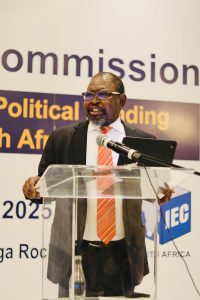
Finance Minister Enoch Godongwana has made a bold call for the thorough auditing of political parties that receive public funds, asserting that transparency and accountability are central to sustaining South Africa’s democratic integrity.
Delivering the keynote address at the Independent Electoral Commission’s (IEC) first-ever Political Funding Symposium in Umhlanga, KwaZulu-Natal, Godongwana emphasised the urgent need for all registered parties to comply with legal financial reporting obligations.
“Words must translate into action,” said Godongwana, lamenting that the majority of political parties have failed to submit audited annual financial statements for the past three years. He reminded delegates that these statements are a legal requirement under the Political Party Funding Act (PPFA), which came into effect in 2021. He called on the IEC to enforce sanctions without fear or favour to protect the credibility of the political system.
Godongwana’s address came as South Africa grapples with declining trust in political institutions and heightened public scrutiny over the use of public funds. Citing reforms introduced through the PPFA, such as donation thresholds, prohibitions on foreign donations, and mandatory disclosures, the Minister warned that persistent loopholes and weak enforcement continue to threaten the integrity of democratic processes.
“We must curtail opportunities for parties with questionable intentions to gain power. This requires a strong fiscus and responsible public finance management, shunning wastage and ensuring traceability of all money flows,” he said, warning that opaque financial systems erode public trust and invite illicit influence.
A major concern raised by Godongwana is that current political finance legislation excludes local government, despite municipalities being the closest tier to citizens and frequently plagued by service delivery failures. He urged a revision of the legislation to cover municipal-level political funding, warning that the absence of transparency at this level undermines governance and weakens democracy at its foundation.
He could not commit to the timeframe for the government to start funding parties contesting the local government elections, saying the discussions involving stakeholders, including the South African Local Government Association, which represents local governments at various stages and levels of government as well as provides support in their efforts of development.
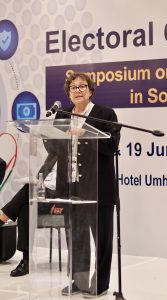
Pic: IEC
Vice Chairperson Janet Love, in her remarks summarising key deliberations from the previous day, acknowledged the pressing concerns raised by stakeholders. She highlighted several critical suggestions from delegates, including the proposal to establish an independent oversight body distinct from the IEC to monitor compliance with funding regulations. This, she noted, would preserve the IEC’s neutrality while ensuring robust accountability mechanisms.
“There is growing concern about the IEC’s dual role as both administrator and enforcer,” said Love. “Delegates are proposing structural reforms that would both strengthen compliance and protect the IEC’s institutional integrity.”
Love also reflected on calls from civil society and smaller political parties for greater access to public funding, which many argue remains skewed in favour of larger, established parties. There was broad consensus that transparent, equitable funding is necessary to ensure a level playing field and to deepen participatory democracy.
Godongwana echoed these sentiments, calling for an eventual move towards full public funding of political parties, with a fair and transparent formula to determine allocations. He underscored the need to align political finance laws with broader efforts to fight corruption, reform procurement systems, and close legislative gaps.
“We must build a system that empowers voters, strengthens institutions, and upholds the values of the Constitution,” he concluded.
ENDS