Events
Standard Bank and SANEF Congratulate the Winners of the 2025 Standard Bank Sikuvile Journalism Awards

29 June 2025
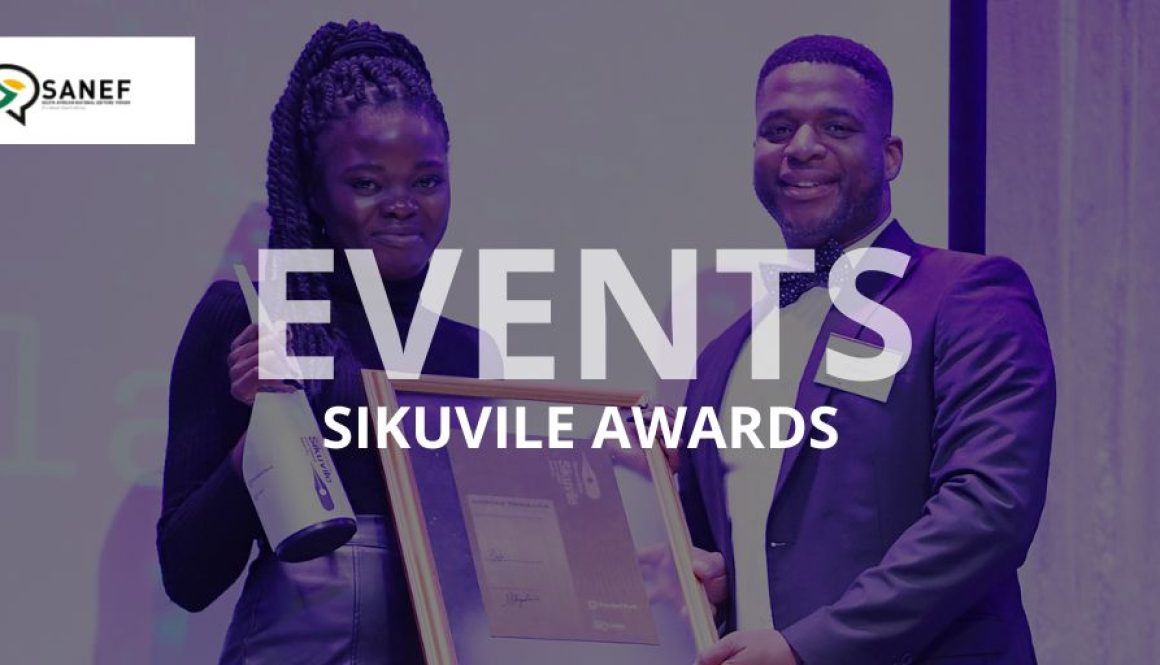
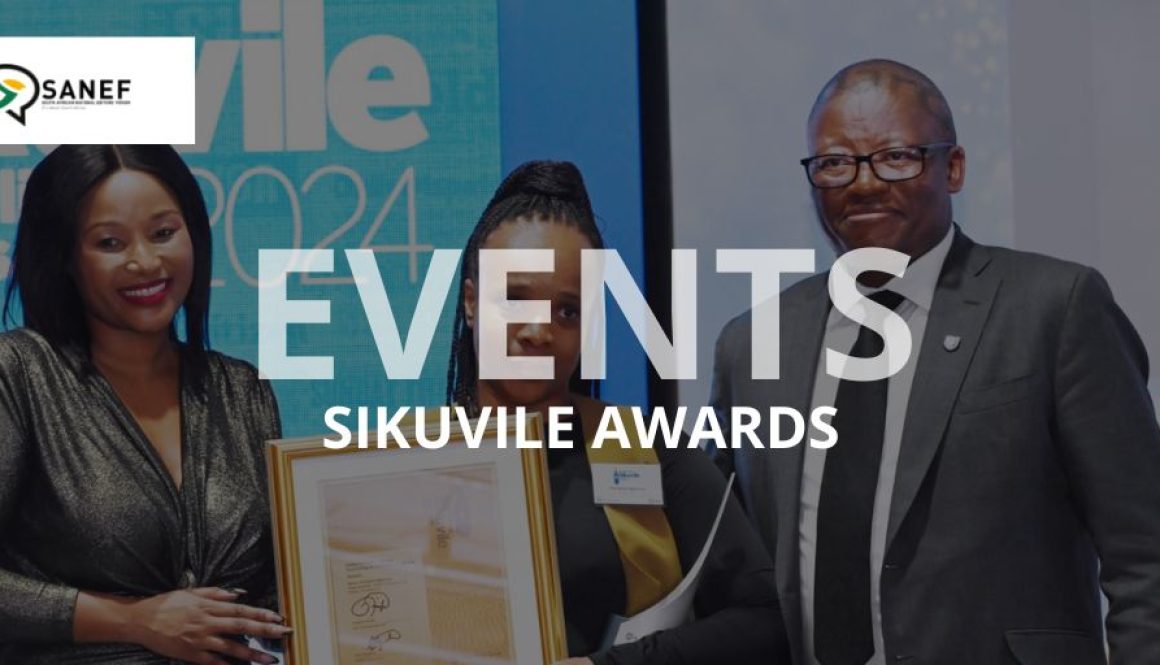
The South African National Editors’ Forum (SANEF), in partnership with Standard Bank, the proud sponsor of the Sikuvile Journalism Awards, extends congratulations to all the winners of the 2025 Standard Bank Sikuvile Journalism Awards, which took place last night at The Venue in Melrose Arch, Johannesburg.
The evening celebrated journalistic excellence and integrity, recognising the brave, ethical, and impactful work done by South African journalists across print, digital, broadcast, and multimedia platforms.
A special and hearty congratulation goes to Kyle Cowan of News24, named Journalist of the Year. The judges praised Cowan’s exceptional investigative reporting on the 18 March 2023 assassinations of Cloete and Thomas Murray, a father-and-son liquidation team, calling it “remarkable in both ability and tenacity.” The story uncovered key details from police sources and exposed the broader implications of corruption and organised crime. “This underscores the critical role good sources play in investigative journalism,” said the panel.
The Juby Mayet Rising Star of the Year Award went to Buyeleni Sibanyoni of AmaBhungane Centre for Investigative Journalism, whose piece “Joburg awards R263-million water tanker tender to two 20-somethings” exposed red flags including price manipulation, collusion, and irregular tender allocations. The judges hailed the story for its sophistication and the journalist’s promise for future excellence.
The Allan Soga/Standard Bank Chairman’s Lifetime Achievement Award was bestowed upon veteran journalist Phil Mtimkulu for his decades-long commitment to media freedom and the democratic cause. From apartheid-era resistance journalism, the panel said Mtimkulu’s contribution reflects the finest standards of integrity and craftsmanship.

SANEF’s chairperson, Makhudu Sefara, in his address, noted that the global media landscape has become increasingly perilous for journalists. He said that according to the International Federation of Journalists (IFJ), 129 journalists and media workers were killed in 2023, and another 122 in 2024. These brave individuals were not only reporting from a war zone but were often targeted, labelled partisans, and tragically, many were killed along with their families.
He highlighted the central theme of the awards, ‘Guardians of Democracy: Upholding Integrity in a Changing World’, saying journalists must continue serving the public interest through fearless storytelling, safeguard their integrity, and hold fast to the ideals of their craft. “Let us raise our voices against impunity, demand accountability for those who target journalists, and advocate for stronger protections against all forms of threats, old and new.”
Margaret Nienaber, Chief Operating Officer of Standard Bank, praised the profession, saying: “Even in a sea of noise, it is your voice that brings clarity. Even in an age of speed, it is your integrity that brings trust. Journalism isn’t just about reach, it’s about responsibility — about asking the hard questions, telling the hard truths, and standing firm when it matters most.”
The awards ceremony also received a heartfelt message from Standard Bank’s chief executive officer, Sim Tshabalala, who could not attend, telling journalists that “the work you do is so important, and we recognise and value you for it. The independent, serious press – staffed by brave and critical thinkers like yourselves, is essential to shaping opinion and strengthening democracy in South Africa and beyond.”
The 2025 Sikuvile Awards not only celebrated individual excellence but reaffirmed the profession’s collective responsibility in telling the truth, challenging power, and shaping a better society.
List of categories and winners:
| 1. Hard News | WINNER:
Norman Masungwini City Press “South Africa’s worst City Manager”
RUNNER-UP: Ziyanda Zweni and Sino Majangaza Daily Dispatch “Dying of thirst in democracy”
COMMENDATION: Lisalee Solomons and Nicole McCain News 24 “‘Please help us get out’: Trapped survivor speaks from beneath rubble of collapsed George building”
|
| 2. Indigenous Language Reporting | WINNER:
Cleopatra Jones SABC’s Cutting Edge “Human Dumping Site”
RUNNER-UP: Dennis Tshetlhane SABC’s Leihlo la Sechaba “Love Scams”
COMMENDATION: Raymond Mojapelo – SABC’s Leihlo La Sechaba: “Moretshe” Vukosi Mathonsi – SABC’s Ngula ya Vutivi: “Sassa R350”
|
| 3. Community Service Reporting | WINNER:
Tammy Jane Fray GO! & Express “Maternity ward mayhem”
RUNNER-UP: Thembi Siaga Limpopo Mirror “Unregistered school in Mpheni may soon be closed”
COMMENDATION: Shanti Jafta – UD Express: “Lapland residents demand liveable homes”
|
| 4. Investigative Journalism | WINNER:
Kyle Cowan News24 “Murray Murders”
RUNNERS-UP: 1. Pieter-Louis Myburgh Daily Maverick “Ghost company bags R428-million Oxygen plants tender for state hospitals” 2. Devi Govender eNCA “Boys and Girls Town” (1 and 2)
COMMENDATION: Dewald van Rensburg – AmaBhungane: “The #Laundry: City of Gold” Nicky Troll – Carte Blanche: “Black Gold”
|
| 5. Business Journalism | WINNER:
Kabelo Khumalo Business Day “Mystery of former Remgro director’s elusive PhD”
RUNNER-UP: Lyse Comins Mail & Guardian “SABC’s Manas is ‘heartbroken’ over deepfake adverts”
COMMENDATION: Mpho Lakaje – eNCA: “Recycling – From Trash to Treasure”
|
| 6. Features (Print) | WINNER:
Sean Christie GroundUp “Follow the Water”
RUNNER-UP: Giulietta Talevi Currency “The great Joburg art grift”
FINALIST: Don Pinnock – Daily Maverick: “Hunting the Joule”
|
| Features (Broadcast) | WINNER
Luke Daniel and Marvin Charles News24 “No Place to call Home”
RUNNER-UP: Taryn Crossman Carte Blanche “Kidnapping Crisis”
FINALIST: Cleopatra Jones – SABC: “Victims of Hope”
|
| 7. Lifestyle | WINNER:
Charles Leonard Mail & Guardian “The Islamic roots of Afrikaans”
RUNNER UP: Mervyn Naidoo IOL Daily News “Warrior in the Comrades ‘bus driver’ seat”
COMMENDATION: Theunis Strydom – Currency: “Grazing through Uruguay’s beefy heritage”
|
| 8. Columns/Editorials | WINNER:
Garth Theunissen News24 “Mr Kganyago, scary inflation isn’t under your bed, it’s in the Union Buildings” RUNNERS-UP: Shirley de Villiers Currency “Lesufi’s R200bn flight of fancy”
Sisonke Mlamla Daily Dispatch “Tragic food poisoning cases demand urgent action”
COMMENDATIONS: Don Pinnock – Daily Maverick: “Trading in wild things: Major rethink required, for biodiversity’s sake” Zongile Nhlapo – EWN: “Black women on SA TV – if they’re not victims of paedophilia, their private parts are on misogyny blast” Willemien Brummer – Netwerk24: “Hoekom vier ons nie ons plooie en warmgloede nie?”
|
| 9. Visual journalism (Editorial cartoons & graphic layout) | WINNER:
Jeff Wicks, Alex Patrick and Sharlene Rood News24 “Final Footsteps: the Kirsten Kluyts Murder”
RUNNER-UP: Themba Siwela The Citizen “30 Years of Democracy”
COMMENDATIONS: Jonathan Shapiro – Daily Maverick: “The Gnu Dawn” Brandan Reynolds – Business Day: Body of work
|
| 10. News Photographs | WINNER:
Siphiwe Sibeko Reuters “Unrest in Mozambique Following Disputed Elections”
RUNNER-UP: Lulama Zenzile Netwerk24 “Hoe lank nog?”
COMMENDATION: Melinda Stuurman Netwerk24 “Floyd Shivambu quits EFF for MK”
|
| 11. Feature Photographs | WINNER:
Lulama Zenzile Netwerk24 “Mens en dier op knieë langs dieselfde damme”
RUNNER-UP: Felix Dlangamandla Daily Maverick “Down in the River to Pray: Good Friday Baptism ceremony at the Klipriver bridge”
SPECIAL COMMENDATION: Luke Daniel News24 “ON THE ROAD: No water, toilets and electricity but Lourierpark occupiers hope they can call it home.”
|
| 12. Sports Photographs | WINNER:
Theodore Jeptha Netwerk24 “Handre Pollard Flying”
RUNNER-UP: Lefty Shivambu Gallo Images “Flying high to score a goal”
COMMENDATIONS: 1. Deaan Vivier, Netwerk24 “Leeus-breier skud kop oor besluit om nie in doodsnikke uit te skop” 2. Ettienne van Rensburg, Vaalweekblaad “SA se beste landlopers gekroon” |
| 13. Manager/Publisher of the Year | WINNER:
Dunisani Ntsanwisi
|
Further information:
SANEF:
- Reggy Moalusi- Executive Director/071 682 3695 – [email protected]
- Hopewell Radebe- Projects Manager/ 083 582 1734 – [email protected]
- Dzudzie Netshisaulu – Coordinator/Administrator – 079 029 7656 – [email protected]
Minister Godongwana Calls for Auditing of Political Parties at IEC Symposium

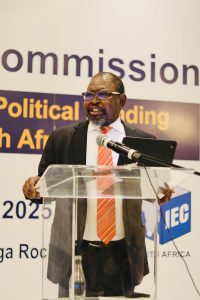
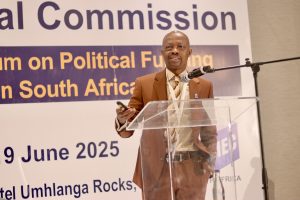
Finance Minister Enoch Godongwana has made a bold call for the thorough auditing of political parties that receive public funds, asserting that transparency and accountability are central to sustaining South Africa’s democratic integrity.
Delivering the keynote address at the Independent Electoral Commission’s (IEC) first-ever Political Funding Symposium in Umhlanga, KwaZulu-Natal, Godongwana emphasised the urgent need for all registered parties to comply with legal financial reporting obligations.
“Words must translate into action,” said Godongwana, lamenting that the majority of political parties have failed to submit audited annual financial statements for the past three years. He reminded delegates that these statements are a legal requirement under the Political Party Funding Act (PPFA), which came into effect in 2021. He called on the IEC to enforce sanctions without fear or favour to protect the credibility of the political system.
Godongwana’s address came as South Africa grapples with declining trust in political institutions and heightened public scrutiny over the use of public funds. Citing reforms introduced through the PPFA, such as donation thresholds, prohibitions on foreign donations, and mandatory disclosures, the Minister warned that persistent loopholes and weak enforcement continue to threaten the integrity of democratic processes.
“We must curtail opportunities for parties with questionable intentions to gain power. This requires a strong fiscus and responsible public finance management, shunning wastage and ensuring traceability of all money flows,” he said, warning that opaque financial systems erode public trust and invite illicit influence.
A major concern raised by Godongwana is that current political finance legislation excludes local government, despite municipalities being the closest tier to citizens and frequently plagued by service delivery failures. He urged a revision of the legislation to cover municipal-level political funding, warning that the absence of transparency at this level undermines governance and weakens democracy at its foundation.
He could not commit to the timeframe for the government to start funding parties contesting the local government elections, saying the discussions involving stakeholders, including the South African Local Government Association, which represents local governments at various stages and levels of government as well as provides support in their efforts of development.

Pic: IEC
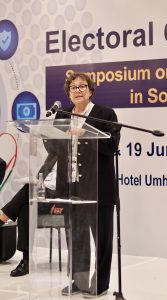
Vice Chairperson Janet Love, in her remarks summarising key deliberations from the previous day, acknowledged the pressing concerns raised by stakeholders. She highlighted several critical suggestions from delegates, including the proposal to establish an independent oversight body distinct from the IEC to monitor compliance with funding regulations. This, she noted, would preserve the IEC’s neutrality while ensuring robust accountability mechanisms.
“There is growing concern about the IEC’s dual role as both administrator and enforcer,” said Love. “Delegates are proposing structural reforms that would both strengthen compliance and protect the IEC’s institutional integrity.”
Love also reflected on calls from civil society and smaller political parties for greater access to public funding, which many argue remains skewed in favour of larger, established parties. There was broad consensus that transparent, equitable funding is necessary to ensure a level playing field and to deepen participatory democracy.
Godongwana echoed these sentiments, calling for an eventual move towards full public funding of political parties, with a fair and transparent formula to determine allocations. He underscored the need to align political finance laws with broader efforts to fight corruption, reform procurement systems, and close legislative gaps.
“We must build a system that empowers voters, strengthens institutions, and upholds the values of the Constitution,” he concluded.
ENDS
IEC Political Funding Symposium Flags Public Trust Crisis in SA

As the Independent Electoral Commission (IEC) of South Africa convened its landmark Political Funding Symposium in Durban to discuss progressive models for financing political activity, a sobering report by the Human Sciences Research Council (HSRC) jolted the conversation into reality: public trust in political parties and politicians is at an all-time low.
According to the nationally representative research, only 17% of South Africans express confidence in political parties, while a mere 14% trust politicians.
You can access the HSRC research report here.
The research, commissioned by the IEC, paints a bleak picture of the nation’s political mood. A staggering 80% of South Africans believe the country is headed in the wrong direction, while 58% express discontent with democracy itself.
Despite this, 66% say they would still vote if elections were held tomorrow, signalling a persistent, if not a strained, commitment to democratic participation.

Perhaps most telling is the public’s unwillingness to financially support the very system meant to represent them and protect the country’s democratic elections from foreign interference through anonymous and possibly foreign political funding.
The research finds that only 9% of South Africans have ever donated to a political party, and among those who haven’t, 73% express no interest in ever doing so. Even the state-backed Multi-Party Democracy Fund (MPDF), designed to depoliticise donations and reduce elite capture, has failed to gain traction. Over half of South Africans have never heard of it, and nearly three-quarters are unwilling to contribute, even when offered tax rebates.
The findings suggest a deep alienation from the political class. The reasons for public reluctance are varied: a lack of trust in politicians, ignorance of the regulatory frameworks, scepticism and fears of misuse of funds, and sheer economic hardship. Those more politically engaged or already party members were slightly more inclined to donate, but even this effect was weak, the document finds.
Implemented in 2021 and amended in 2024, the Political Funding Act (PFA) was designed to enhance transparency and fairness in party financing. It mandates the disclosure of large private donations and introduced the MPDF. However, awareness of the Act remains alarmingly low, with 61% of South Africans never having heard of it. Education, wealth, and political engagement were significant predictors of awareness, leaving large segments of the population uninformed.
Even among those aware of the PFA, the document says support is tepid. Just 42% of the public support laws like the PFA, while 29% remain neutral and 16% are unsure. Only a slim majority (55%) support tracking political party expenditures to verify donation claims, an essential step towards detecting fraud or manipulation.
Despite overall distrust, 64% of South Africans still believe the IEC should be responsible for overseeing political funding transparency. Yet confidence in the Commission’s ability to enforce compliance is fragile: only 9% express very high confidence, and 19% say they have no confidence at all. This signals the need not only for better capacity but also for a public-facing strategy to restore trust in the institution’s oversight role.
Recommendations from the HSRC Research
The HSRC report doesn’t stop at diagnosis. It puts forward a series of concrete recommendations, including:
- Enhanced Public Education Campaigns: To raise awareness of the Political Funding Act and the MPDF across all socio-economic groups.
- Increased IEC Capacity: Calls to improve the technical, investigative, and auditing capabilities of the IEC to enforce compliance.
- Hybrid Regulatory Models: Shift from a purely income-based disclosure regime to a hybrid income-and-expenditure model, which could expose discrepancies between reported donations and actual campaign spending.
- Strengthening Gender Equity: Encourage the use of public funds to promote gender-responsive political financing and better support for women candidates.
- Collaboration with Other Institutions: Include entities like the Auditor-General, SARS, and the Hawks in financial monitoring efforts.
The delegates in the symposium described the findings of the HSRC’s report as a wake-up call for political renewal in the country, and not just academic. As South Africa stares down another electoral cycle next year for the local government, the data mirror a citizenry that is politically exhausted, economically constrained, and increasingly disillusioned.
If parties, regulators, and civil society fail to respond to this crisis of trust with urgency, the country risks watching its democratic institutions wither from the inside out.
The IEC’s Political Funding Symposium may have been a forum for policy ideas, but the HSRC report made it clear: without public trust, even the best regulations may be dead on arrival.
ENDS
The IEC’s Inaugural Symposium Assesses South Africa’s Political Funding Landscape Four Years On

Picture supplied by IEC.
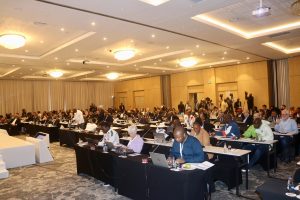
The Electoral Commission of South Africa (IEC) is hosting a groundbreaking symposium on political funding in South Africa in uMhlanga, KwaZulu-Natal, aimed at evaluating, reflecting on, and strategising on funding political activity in the country.
The symposium takes place four years after the implementation of the Political Party Funding Act (PPFA) of 2018, which was amended and renamed the Political Funding Act (PFA) in 2024 to include independent candidates. This legislative evolution reflects a broader commitment to promoting transparency, accountability, and integrity in South Africa’s democratic processes.
It brings together a wide range of stakeholders, including political party leaders, Members of Parliament, civil society organisations, business leaders, and members of the media including SANEF and the Press Council South Africa, creating a unique space for inclusive dialogue.
In his opening remarks, IEC Chairperson Mosotho Moepya described the gathering as “a pivotal moment in the ongoing efforts to strengthen democratic governance and electoral integrity.” He emphasised that the Act was “a deliberate and bold commitment to enhancing transparency, fairness, and accountability” and underscored that inclusive, multi-stakeholder engagement. This was essential to ensuring the credibility and legitimacy of any future reforms.
“This symposium reflects a fundamental commitment to inclusive governance,” Moepya said, “where the health and integrity of our democracy are recognised as a shared responsibility.”
Reflecting with Purpose, Not Rhetoric
IEC Chief Electoral Officer Sy Mamabolo echoed these sentiments, describing the adoption of the Act as “a milestone in our collective effort to bring greater transparency to political financing.”
Framing the symposium as a moment for honest appraisal rather than celebration, Mamabolo posed a series of critical questions: “Has the law delivered on its promise? Has it safeguarded our democracy? Has it enabled, rather than hindered, the healthy competition of ideas in the political marketplace?”
He called on all participants, regardless of ideology, to seize this opportunity to strengthen the legislation: “No political ambition should rest on secret money, undue influence, or inequitable advantage.”

A highlight of the symposium was a presentation by IEC Deputy CEO George Mahlangu, who provided a comprehensive overview of the PFA’s implementation, outlining achievements and ongoing hurdles.
Key Gains Under the Political Funding Act
- Greater Transparency and Public Awareness
The regular publication of donation reports has boosted public trust and accountability. The IEC’s quarterly disclosures of political donations have empowered voters with insights into “who funds whom.” While public understanding of the Act remains limited, awareness is gradually growing. - Stronger Regulatory and Institutional Framework
The PFA has introduced clear rules on political finance and donor behaviour. The IEC has developed new systems, including the Online Political Funding System (OPFS), and built internal capacity through training. The Commission’s powers to enforce compliance, through fines and legal recourse, have been significantly enhanced. - Improved Compliance and Sound Financial Management
Most represented political parties now meet disclosure requirements. The IEC itself has received three consecutive clean audit outcomes from the Auditor-General, with a fourth currently underway. Even some unrepresented parties have begun submitting audited statements, suggesting a broader culture of accountability is taking root.
Persistent Challenges
Despite meaningful progress, several challenges persist:
- Limited Public Awareness
Awareness of the Act among the general public remains low, leading to misconceptions and misplaced expectations—such as calls for investigations when legal thresholds are not met. This knowledge gap weakens public oversight and undermines the Act’s goals. - Uneven Compliance, Especially by Unrepresented Parties
While compliance is relatively strong among parties represented in Parliament, some only disclose funds late in the financial year. Compliance among unrepresented political parties remains critically low, skewing the level playing field and introducing opacity into parts of the political system. - Resource Constraints and Legal Loopholes
Many smaller or unrepresented parties lack the resources to comply fully. Mahlangu also flagged legal loopholes, particularly around anonymous donations and foreign contributions. Although foreign governments are barred from donating, foreign entities may still contribute up to R5 million, earmarked for policy and training, raising concerns about potential backdoor influence.
Charting the Way Forward
The symposium affirms South Africa’s resolve to build a more accountable political funding system. While major strides have been made, challenges such as public engagement, uneven compliance, financial inequity, and regulatory loopholes require urgent and sustained attention.
The focus remains on sharpening the implementation of the Political Funding Act and ensuring it lives up to its founding promise: to guard the democratic space from corruption, secrecy, and undue influence.
Ends
Judges Decide on the Finalists of the 2025 Edition of the Standard Bank Sikuvile Journalism Awards


Deadline Extended for Standard Bank Sikuvile Journalism Awards Submissions
01 April 2025
It’s no April’s Fool joke, the deadline for the entries to the 2025 Standard Bank Sikuvile Journalism Awards has been extended.
The South African National Editors’ Forum (SANEF) has decided to extend the deadline and allow those who missed yesterday’s deadline to enter.
Journalists who may have missed the initial deadline on 31 March 2025 now have another golden opportunity to submit their outstanding work for consideration. The new submission deadline is next Monday, 7 April 2025.
Sane officially opened the call for entries on 3 February 2025, inviting journalists across South Africa to showcase their exemplary work published or broadcast between 1 January 2024 and 31 December 2024. The awards celebrate journalistic excellence across various media platforms, including print, online/digital, and broadcast (radio and TV).
Winning journalists will be honoured at a prestigious awards ceremony scheduled for 28 June 2025 at The Venue in Melrose Arch, Johannesburg.
About the Standard Bank Sikuvile Journalism Awards
The Standard Bank Sikuvile Journalism Awards serve as a beacon of excellence, recognising outstanding journalism that informs, educates, and holds power to account. Over the years, these awards have become a cornerstone of journalistic recognition, reinforcing the media’s critical role in South Africa’s democracy.
SANEF is proud to organise the awards for the fourth consecutive year, continuing the legacy previously upheld by the Publishers’ Support Services (formerly PDMSA). The awards highlight exceptional work in categories such as investigative journalism, feature writing, lifestyle journalism, and photojournalism.
Upholding Journalism Standards
At a time when misinformation and disinformation pose serious challenges, the Standard Bank Sikuvile Journalism Awards reaffirm the importance of accurate, fact-based, and ethical reporting. The awards honour the integrity and courage of journalists who strive to uncover the truth and keep the public informed.
SANEF encourages all eligible journalists who have not yet submitted their entries to take advantage of this extended deadline.
- For more information on the submission process, please visit the www.sikuvileawards.co.za website or contact Dzudzie Netshisaulu – Coordinator/Administrator, email: [email protected]
Award Categories
Entries are invited from journalists across all platforms for the following categories:
- Hard News
- Indigenous Language Reporting in Community Media: This category has been refined to entail news articles/broadcasting clips that are the result of proactive reporter enterprise. It is distinct from breaking news and represents stories initiated by the newsroom. Entrants should submit journalistic work that was produced using any of South Africa’s Indigenous languages across media segments, particularly meant to speak to the community the journalists work.
- Community Service Reporting: This category has been remodelled to highlights hyper-local issues crafted from a community interest perspective, to inform, educate, and build resilient communities by amplifying grassroots narratives that matter. These are general community feature and creative journalism stories initiated to capture the depth of community sentiments and concerns. Qualifying entries must be journalistic work produced for and published exclusively in community media platforms in all languages, and not in any commercial or publicly owned news entities.
- Investigative Journalism
- Business Journalism
- Features: The Features category will now have two winners: one for Print and Online platforms, and another for Broadcasting. This is after the judges proposed a split in the Features category between print and broadcast entries.
- Lifestyle
- Columns/Editorials
- Visual Journalism (Editorial Cartoons/Graphic Layout)
- News Photographs
- Feature Photographs
- Sports Photographs
- Manager/Publisher of the Year Award: Recognising exceptional newsroom managers and publishers for their contributions. Entries should include a motivation letter or supporting documents provided by colleagues.
- Juby Mayet Rising Star of the Year: Selected by the jury from category entries to honour emerging talent.
- Journalist of the Year: Selected by the jury from category entries for exemplary contributions to the field.
- The Allan Kirkland Soga / Standard Bank Chairman’s Lifetime Achievement Award: Celebrating sustained and extraordinary contributions to journalism by an individual who has demonstrated impeccable ethics and craft excellence.
Submission Details
Journalists and media professionals are encouraged to submit their entries via the official awards platform. For more information on the submission process and guidelines, please visit the Standard Bank Sikuvile Awards’ website.
Join us in recognising the dedication, integrity, and talent of South Africa’s finest journalists. Be part of the celebration of media excellence at the 2025 Standard Bank Sikuvile Journalism Awards.
To enter the awards, go to https://sikuvileawards.co.za.
Further information:
SANEF:
- Reggy Moalusi- Executive Director/071 682 3695 – [email protected]
- Hopewell Radebe- Projects Manager/ 083 582 1734 – [email protected]
- Dzudzie Netshisaulu – Coordinator/Administrator – 079 029 7656 – [email protected]
Renewed Call: Standard Bank Sikuvile Journalism Awards 2025 Submission Deadline Approaching!
20 March 2025
South Africa’s journalists, the countdown has begun! The deadline for submissions to the prestigious 2025 Standard Bank Sikuvile Journalism Awards is fast approaching — March 31, 2025.
Do not let procrastination cost you the recognition you deserve. This is your chance to showcase impactful journalism — whether in investigative reporting, breaking news, feature writing, business and politics, or photojournalism.
There will be no extensions due to the tight judging schedule and the organisational work required ahead of the awards ceremony on Saturday, June 28, 2025.
Since the call for entries opened on February 3, journalists across print, digital, and broadcast media have been invited to submit their best work from January 1 to December 31, 2024. If you have not submitted yet, now is the time to act!
Why Wait? Seize the Opportunity!
SANEF’s chairperson and Sunday Times editor, Makhudu Sefara, urges journalists to avoid last-minute submissions:
“Procrastination is the enemy of opportunity. Submit your entries while there’s still time—do not risk missing out due to unforeseen circumstances,” Says Sefara.
The Standard Bank Sikuvile Journalism Awards are South Africa’s yardstick for journalistic excellence, recognising outstanding work that informs, inspires, and holds power to account. As the leading media advocacy organisation, SANEF continues to champion ethical and high-quality journalism.
Do not Miss Out—Submit Today!
The Standard Bank Sikuvile Journalism Awards have become the gold standard of journalistic excellence in South Africa. As SANEF continues to oversee these prestigious awards, they remain a benchmark for integrity, quality, and impact in journalism.
Be among the country’s top journalists celebrated for their outstanding work. Submit your entries long before March 31 to [email protected]
About the Standard Bank Sikuvile Journalism Awards
The Standard Bank Sikuvile Journalism Awards are designed to encourage and recognise outstanding journalistic work across South Africa. Over the years, these awards have become a cornerstone of journalistic excellence, highlighting the critical contributions of the media to our democracy.
SANEF is proud to organise the awards for the fourth consecutive year in 2025, having taken over from the Publishers’ Support Services (formerly PDMSA). The awards celebrate excellence across all media platforms, including print, online/digital, and broadcast (radio and TV). They shine a spotlight on exceptional work in categories such as investigative reporting, feature writing, lifestyle journalism, and photojournalism.
Upholding Journalism Standards
The Standard Bank Sikuvile Awards underscore the importance of groundbreaking, accurate, fact-based, truthful, and fair reporting in an era where misinformation and disinformation pose significant challenges to the media landscape. They serve as a testament to the vital role of the Fourth Estate in safeguarding democracy.
Award Categories
Entries are invited from journalists across all platforms for the following categories:
- Hard News
- Indigenous Language Reporting in Community Media: This category has been refined to entail news articles/broadcasting clips that are the result of proactive reporter enterprise. It is distinct from breaking news and represents stories initiated by the newsroom. Entrants should submit journalistic work that was produced using any of South Africa’s Indigenous languages across media segments, particularly meant to speak to the community the journalists work.
- Community Service Reporting: This category has been remodelled to highlight hyper-local issues crafted from a community interest perspective, to inform, educate, and build resilient communities by amplifying grassroots narratives that matter. These are general community features and creative journalism stories initiated to capture the depth of community sentiments and concerns. Qualifying entries must be journalistic work produced for and published exclusively in community media platforms in all languages, and not in any commercial or publicly owned news entities.
- Investigative Journalism
- Business Journalism
- Features: The Features category will now have two winners: one for Print and Online platforms, and another for Broadcasting. This is after the judges proposed a split in the Features category between print and broadcast entries.
- Lifestyle
- Columns/Editorials
- Visual Journalism (Editorial Cartoons/Graphic Layout)
- News Photographs
- Feature Photographs
- Sports Photographs
- Manager/Publisher of the Year Award: Recognising exceptional newsroom managers and publishers for their contributions. Entries should include a motivation letter or supporting documents provided by colleagues.
- Juby Mayet Rising Star of the Year: Selected by the jury from category entries to honour emerging talent.
- Journalist of the Year: Selected by the jury from category entries for exemplary contributions to the field.
- The Allan Kirkland Soga / Standard Bank Chairman’s Lifetime Achievement Award: Celebrating sustained and extraordinary contributions to journalism by an individual who has demonstrated impeccable ethics and craft excellence.
Submission Details
Journalists and media professionals are encouraged to submit their entries via the official awards platform. For more information on the submission process and guidelines, please visit Standard Bank Sikuvile Awards’ website.
Join us in recognising the dedication, integrity, and talent of South Africa’s finest journalists. Be part of the celebration of media excellence at the 2025 Standard Bank Sikuvile Journalism Awards.
To enter the awards, go to https://sikuvileawards.co.za.
Further information:
SANEF:
- Reggy Moalusi- Executive Director/071 682 3695 – [email protected]
- Hopewell Radebe- Projects Manager/ 083 582 1734 – [email protected]
- Dzudzie Netshisaulu – Coordinator/Administrator – 079 029 7656 – [email protected]
Tony Karon on Digital-First Newsrooms and Storytelling in the Global South
Navigating the Future: Tony Karon on Digital-First Newsrooms and Storytelling in the Global South
As the global media landscape shifts towards digital-first strategies, journalists must rethink storytelling approaches to remain relevant. This was the central message from Tony Karon a seasoned journalist and editor at AJ Plus, who addressed the SANEF Young Women Leaders in News Media Seminar on Thursday, March 13, 2025.
Speaking to a room full of aspiring and established journalists, Karon shared insights on the evolution of digital-first newsrooms and the role of journalists in challenging dominant Western narratives.
Digital-First Journalism: A New Paradigm
Karon originally from South Africa and now working with Al Jazeera’s digital platform, emphasised that digital-first journalism requires a shift in perspective. Unlike traditional newsrooms with fixed programming schedules, platforms like AJ Plus publish directly into social feeds, competing for attention alongside major Western media outlets such as CNN, BBC, and The New York Times.
“You have one shot to make an impact,” Karon explained. “We do not follow the ‘he said, she said’ format of mainstream news. Instead, we focus on whose voices are being ignored and whose stories are not being told.”
The traditional structure of news prioritises statements from officials and those in power, but digital-first platforms like AJ Plus adopt a bottom-up approach, amplifying the voices of those experiencing global crises firsthand. This shift is particularly evident in the outlet’s coverage of Gaza, where they prioritise stories from civilians rather than government representatives.
Decentring the Western Narrative
A major theme of Karon’s talk was the need to challenge and deconstruct Western-centric narratives that have long dominated global journalism. He praised South Africa’s vocal stance on Palestine, noting how the country has emerged as a leader in advocating for media narratives that expose imbalances of power.
“In many ways, Al Jazeera was founded to address these imbalances,” he noted. “The question isn’t just about presenting facts, but about which facts matter and whose perspectives are included.”
Karon highlighted how global audiences—especially young people—are increasingly disillusioned with traditional media narratives. Platforms like TikTok, often dismissed as trivial, are hosting deep discussions about history and politics. “Young people are not disengaged. They do not trust the old ways of storytelling,” he said.
The Toolbox for the Future Journalist
For those looking to thrive in a digital-first newsroom, Karon stressed the importance of adaptability, multilingualism, and a global outlook. He recounted experiences from his newsroom, where colleagues seamlessly switch between English, Arabic, French, and Mandarin—an asset in an increasingly interconnected world.
“Adding a language to your skill set opens up job opportunities and allows you to engage with diverse sources directly,” he advised.
Additionally, he underscored the importance of recognising the shifting geopolitical landscape. The era when U.S. policy dictated global outcomes is waning, he argued, and journalists in the Global South must embrace their agency in shaping narratives that matter to their communities.
A Call to Action
Karon’s message to young journalists was clear: the future of journalism belongs to those who embrace new formats, prioritise underrepresented voices, and think beyond the traditional structures of power.
“Your world is not centred in America,” he concluded. “It’s up to you to tell the stories that matter to your people.”
His talk energised the audience, reinforcing the idea that digital-first journalism is not just about technology, but about reclaiming storytelling for those whose voices have too often been ignored.
- The workshop, organised by Sisanda Nkoala, SANEF’s Western Cape convenor, in collaboration with multi-award-winning veteran journalist, Crystal Orderson, focuses on empowering young women in journalism.
- Sisanda highlighted the underrepresentation of women in leadership positions within the news media, despite a majority of journalism students being women. The event aims to inspire and equip participants with the tools needed to effect change in the industry.
- The workshop focused on empowering young women journalists by addressing the underrepresentation of women in leadership roles within the news media. Sisanda Nkoala highlighted the disparity between the number of female journalism students and their presence in leadership positions, expressing gratitude to contributors like Dzudzie Netshisaulu, SANEF administrator and events organiser.
- The event included a video featuring messages from women leaders in the industry and aimed to provide attendees with inspiration and practical tools to navigate their careers. Dianne Walker and Judy Sanderson shared their experiences and advice, emphasising the importance of understanding management dynamics, professionalism, and strategic networking for aspiring future young women leaders.
- The program featured a panel of distinguished women in media, including Crystal Orderson, Pam Zokufa, Anne Wentzel, Deirdre Ewing, and Zulpha Khan, who shared insights from their diverse backgrounds.
- Deirdre recounted her journey into journalism, emphasising the importance of public broadcasting and local storytelling. The discussion also touched on the evolving media landscape, including the challenges posed by technology and the need for ethical standards in journalism.
- Deirdre highlighted the financial challenges facing traditional broadcasters like the SABC and the necessity for journalists to balance storytelling with financial viability, advocating for credibility over speed in news reporting. The overall aim was to equip the next generation of women journalists with the knowledge and tools needed to succeed in a changing industry. Ends